Standard operating procedure (SOP) adherence, often called SOP compliance, is the share of observed SOP steps performed as written or as an approved variant. Teams measure it by turning each step into an observable checkpoint, counting every observation into fixed categories, sampling across all shifts, and comparing rounds over time to catch drift.
The SOP is signed off and the training records are complete. Output and quality still vary from shift to shift, and nobody can say which steps slip.
For a count that holds up:
- Count at step level, against a condition anyone on the floor can observe.
- Agree the approved variants before the first round.
- Sample every shift, including nights and weekends.
- Plot each round in the order it was collected.
What SOP Adherence and SOP Compliance Mean
SOP adherence and SOP compliance describe the same measurement task: how often the steps of a standard operating procedure are performed as designed on the floor. Standard work adherence is the lean name for the same idea. All three ask one thing of each step: did it follow the SOP, or a variant the team has approved?
The unit of measure is one SOP step or sequence checkpoint, paired with the observable condition that shows the step was done. "Guard closed before cycle start" and "cart at the pick face" are both checkpoints an observer can confirm. A step with no observable condition cannot be counted until the team defines one.
Writing or rewriting the SOP sits outside this guide. The method starts from the SOP as it stands today.
What to Count at Each SOP Step
Every observation lands in exactly one of four categories, defined before the first round and kept fixed after it. Fixed categories let two observers on two shifts count the same step the same way, so results from different rounds can be compared.
Four Fixed Categories
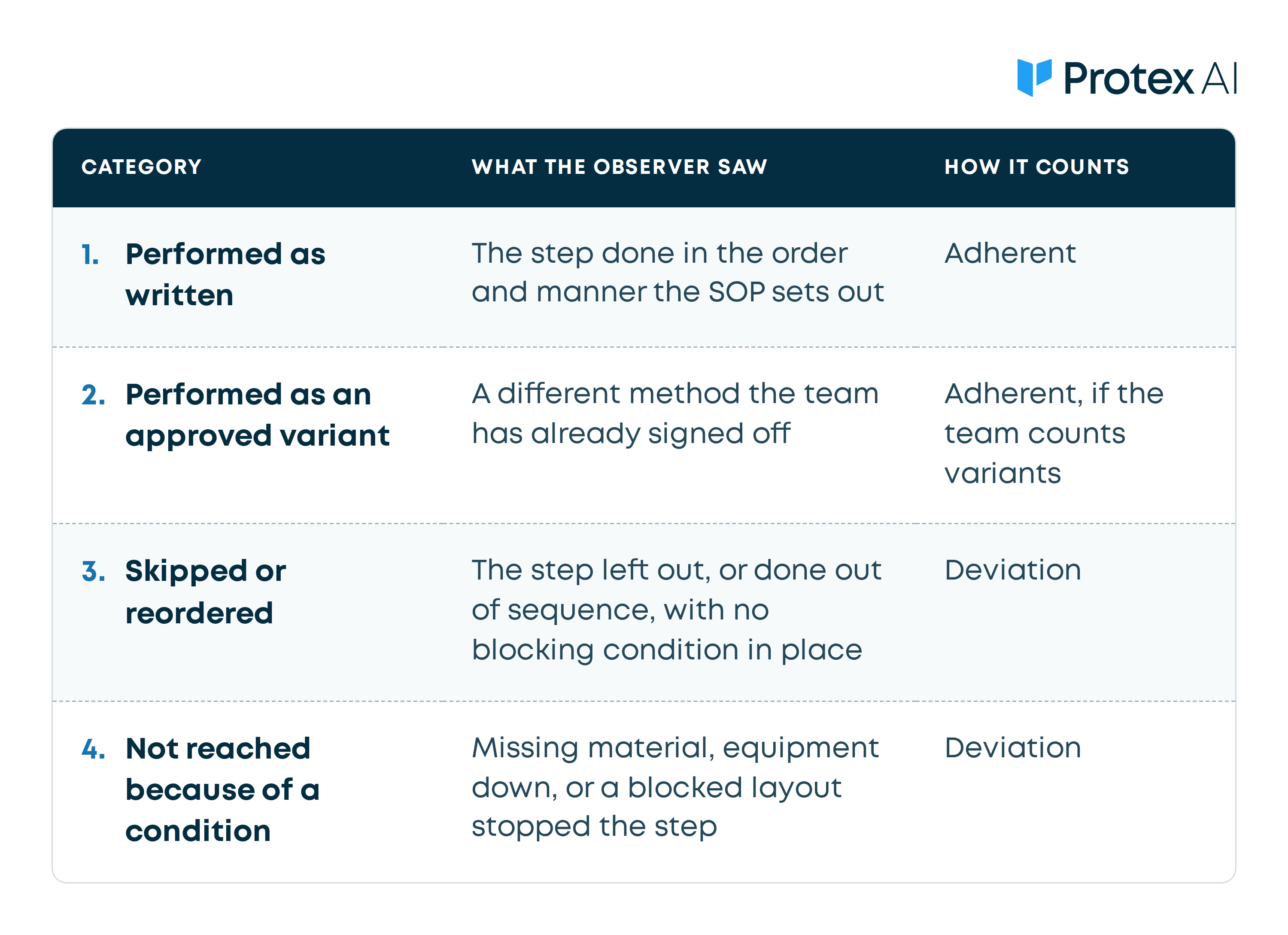
A deviation is any departure the team has not approved. The last two categories call for different fixes: one points at how the step is done, and the other at the conditions around it.
The Approved-Variant List
Agree the list before counting starts, write it down, and have quality or the continuous improvement (CI) lead sign it off. A new variant found during a round counts as a deviation until it has been reviewed and added to the list.
What Each Observation Records
Each observation records the date, shift, line or zone, SOP and step, the category, the condition seen when a step was not reached, and the observer. Operator names stay off the record, because the measurement is about the step.
How to Calculate an SOP Compliance Rate
The SOP compliance rate is the number of steps performed as written, plus approved variants if the team counts them, divided by the number of steps observed, times 100. The team decides once if approved variants count as adherent, then keeps that choice fixed so every round compares with the last.
How Results Roll Up
Results roll up in one line: step, then SOP, then line or zone, then shift. A weak step inside a healthy SOP stays visible, and a weak shift shows up against the others.
A Worked Example
The numbers below illustrate the arithmetic only. A team makes 40 observations of a five-step SOP, which gives 200 step observations. Of those, 170 were done as written, 12 as an approved variant, 10 were skipped or reordered, and 8 were not reached because of a condition.
The rate is 85 percent when only steps done as written count, and 91 percent with approved variants included. Report the 8 steps not reached on their own line as well. They point to a fix outside the SOP, such as material supply or equipment repair, which the rate on its own would hide.
Sampling Every Shift
Adherence results only hold if every shift gets observed, including nights and weekends. A sample drawn from day shifts alone describes day shifts, and the steps that slip when fewer supervisors are around stay out of the count. Four choices shape the sample: timing, observer method, size, and frequency.
- Fixed Rounds and Random Time Slots
Fixed rounds are easy to staff, and the floor soon knows when they happen. Predictable timing is one of the reasons process audits miss drift. Random time slots give a fairer picture of normal work. A mix of the two can serve both needs, with a fixed round for routine checks and random slots added on every shift.
- How Observers Work
Observe without stepping in, and record each step against the checkpoint list as it happens. Rotate observers across lines and shifts, so one person's blind spots do not repeat in every round.
- Sample Size
Base the sample on the team's own run rate, the decision the result will support, and how precise the result needs to be. A work sampling formula can help a team that wants a number. Treat any calculation as illustrative, since the right size depends on the purpose of the check.
- How Often to Check Each Step
Check high-risk or high-variation steps more often than stable, low-risk ones. A step that has held steady for several rounds can move to a lighter schedule, and a step that starts to slip moves back.
Spotting Drift Across Rounds
Drift is a trend across repeated rounds. One low round is a single data point, and it may reflect a short staffing gap or an unusual product mix. A run of falling rounds on the same SOP or the same shift is drift, and it needs a response before the next audit finds it.
Plot each round's rate in the order it was collected, by SOP and by shift. The National Institute of Standards and Technology (NIST) engineering statistics handbook calls this a run sequence plot. Look for a sustained trend in one direction, since a small movement between rounds can be ordinary variation.
Keep the shifts on the same chart, so a gap between them stays visible. Two shifts that start level and pull apart over several rounds point to a difference in how the step is run, or in the conditions each shift works under.
What to Do When a Deviation Appears
Each deviation takes one of three routes, set by what the observation shows. The route decides who acts and what changes, so record it beside the deviation before anyone starts on a fix.
- When the SOP Is Outdated
Sometimes the floor has found a better way, and the written step lags behind. Review the method, then update the SOP or the variant list.
- When a Condition Blocks the Step
A condition outside the step, recorded as not reached, needs its own fix: material supply, equipment, or layout. Fix the condition, then recheck the step in the next round.
- When a Step Is Skipped
A step skipped with no blocking condition calls for coaching at team level, in the meeting where the SOP is discussed, and a recheck in the next round. Designing the training itself sits outside this guide.
Where Video Adds Evidence to an SOP Adherence Check
The method above runs without a camera. Video adds observations and a record of each one, while the categories, the rate, the sample plan, and the routes stay the same.
What Video Adds
Where cameras cover the step:
- A disputed observation can be checked against a saved event clip instead of memory.
- Shifts and hours with no observer on the line still get counted.
- The same step gets compared across days and shifts against the same checkpoint.
- A clip shows what surrounded a deviation, such as missing material, a blocked layout, or a sequence gap.
A Picking Example
In an example from the Beyond the Clipboard whitepaper, a global e-commerce and logistics company using Protex AI measured a picking step with computer vision. The procedure required a cart when workers carried multiple packages to distant bins. Across shifts, 31 percent of picks were completed without the required cart, and those picks took roughly 18 seconds longer on average.
The results also pointed to the shifts that needed focused training.
What Video Cannot Count
Video measures only what a camera can see in a configured zone, so the observer round still covers the rest:
- A step outside camera view goes uncounted.
- Steps hidden by people, racks, or equipment can be missed.
- Video shows observable conditions and movements, and it does not read intent or fine hand actions inside a task.
Protex runs on cameras already in place, with a secure edge device on site. It does not perform biometric identification, and results are reported at process and zone level. Privacy controls, including anonymization, facial or full-body blurring, ghosting, and videoless operation, are customizable to each organization's policies, legal requirements, and workforce agreements.
Review Each SOP Once a Month
Once a month, each SOP under measurement gets a written review that brings the rate by shift, the run plot, and the open deviations with their routes together. The same review records changes to the approved-variant list and the SOPs to add or drop next month.
File each review with the SOP itself, so the next revision starts from measured evidence.
The team defines the checkpoints, agrees the variants, reviews disputed observations, chooses the route for each deviation, and decides when an SOP changes. Video adds observations to that work, and the decisions stay with people.
SOP Compliance FAQs
Which SOPs Should a Team Measure First?
Start with one to three SOPs where a skipped step costs the most, through quality escapes, rework, or safety exposure, or where results vary most by shift. A short list lets the team settle the categories and the rounds before the workload grows. Add more SOPs once the first ones run smoothly.
Should Operators See SOP Adherence Results?
Yes, at line, zone, and shift level, in the same team meetings where the SOP gets discussed. Seeing the results helps teams flag outdated steps and blocking conditions early. Keep names out of every report, so the conversation stays on the steps and the conditions around them.
Does Adherence Measurement Replace Layered Process Audits?
The measurement feeds layered process audits with a wider sample and a consistent record. Audit leaders still run the audit, ask questions at the line, and decide on changes. The adherence data gives them a sharper starting point for each visit.
Extend the Rounds to Every Shift
Observer rounds cover the shifts a team can staff. For the hours in between, manufacturing process compliance software from Protex can add camera evidence to the same checkpoints inside configured zones.
Check Out Our Industry
Leading Blog Content
EHSQ industry insights, 3rd Gen EHSQ AI-powered technology opinions & company updates.