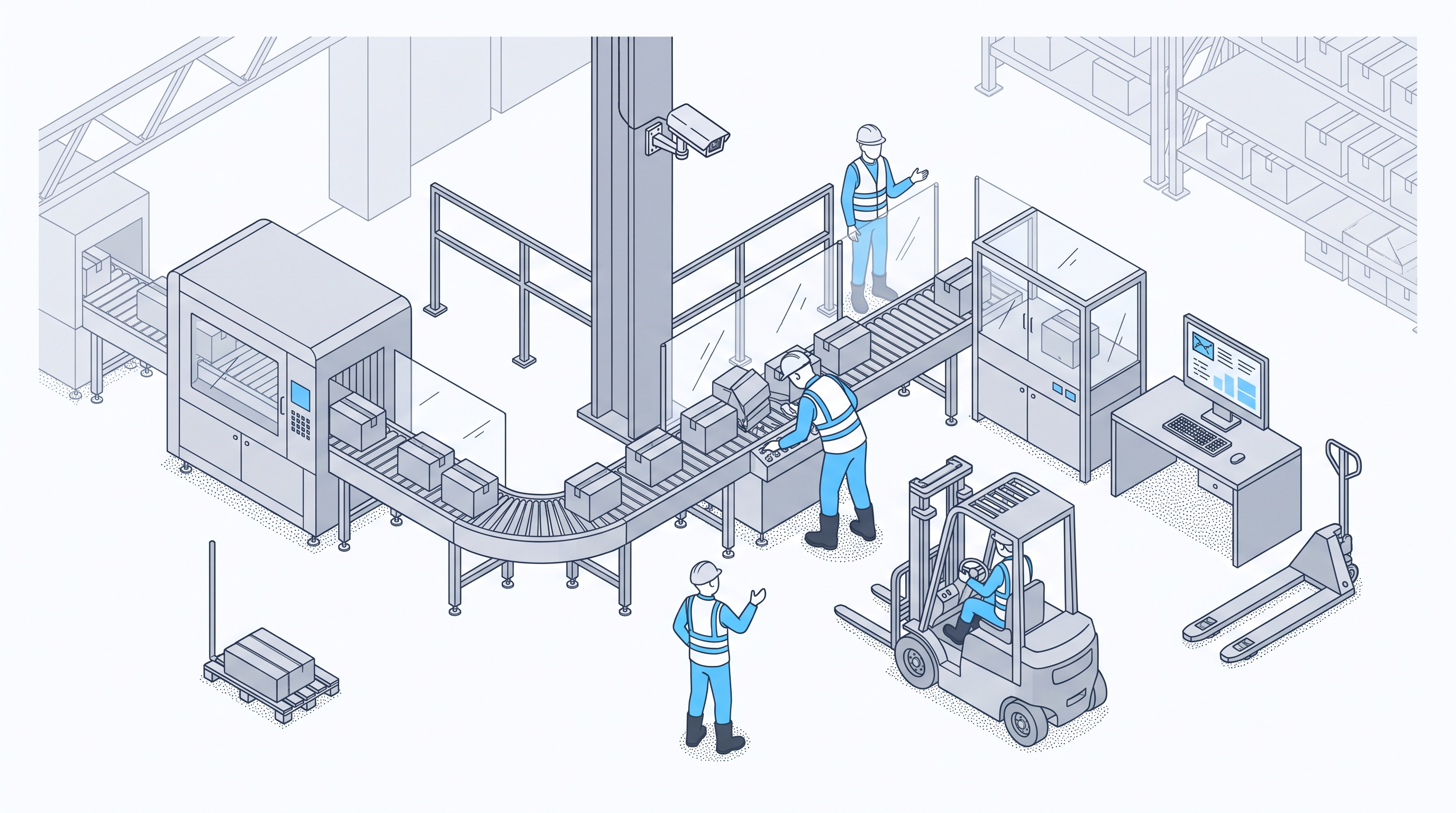

Industrial businesses have spent decades improving how they measure performance. Advances in AI are creating an opportunity to understand the physical work behind those results, with implications for safety, productivity and the future of automation.
Consider a busy distribution centre where forklifts regularly queue at an intersection near a production area.
The safety team is concerned about the frequency of interactions between vehicles and pedestrians. Operations is investigating why material movements take longer than expected. Production is frustrated by inconsistent replenishment times.
Each team has a legitimate problem to solve, with its own metrics, reporting and priorities. What may be less obvious is that all three problems could originate from the same congested intersection.
This is a recurring feature of industrial operations. The conditions that make a facility unsafe are often closely related to those that make it inefficient.
Poorly designed workstations create ergonomic risks while introducing unnecessary movement. Congested routes increase the likelihood of collisions while slowing material flow. Unreliable processes contribute to injuries, delays and quality defects.
These relationships are familiar to experienced operators and continuous improvement teams. Yet the systems used to manage industrial performance rarely provide a shared understanding of the physical conditions behind them.
There's a historical reason for this. Industrial technology has largely developed around the activities businesses can reliably record and measure. As a result, manufacturers have sophisticated systems for managing production, inventory and financial performance, but understanding why things happen on the floor still depends heavily on human observation.
Recent advances in AI, particularly computer vision, are beginning to change what's possible. They create an opportunity to make physical work more observable and connect that understanding with the operational data businesses already collect.
This is part of the opportunity for physical AI: systems that can perceive and reason about the physical world, then use that understanding to guide action within it.
The implications could extend well beyond individual AI applications, particularly as factories and warehouses become increasingly automated.
Why so much operational knowledge still lives on the floor
Over the past few decades, industrial businesses have invested heavily in ERP, warehouse management and manufacturing execution systems.
These technologies have transformed how companies plan production, coordinate resources, manage inventory and measure performance. Modern industrial operations would be difficult to imagine without them.
But spend time with a site manager investigating why a production line missed its target, and it becomes clear how much of the explanation still depends on people.
The production system might show that a line experienced 45 minutes of downtime. It may identify the machine responsible and provide information about its operating state. But understanding the broader sequence of events can require conversations with operators, maintenance teams and supervisors.
Perhaps materials weren't available when production resumed. Perhaps an operator had to leave the workstation to retrieve a component. Perhaps the process was restarted several times because of an issue that wasn't captured by the equipment monitoring system.
The same challenge exists in logistics.
A warehouse management system might record when a pallet was requested, picked and delivered. It doesn't necessarily explain why a journey that normally takes four minutes took twelve.
The operator might have encountered congestion, waited for another vehicle to clear an aisle or searched for inventory stored in the wrong location.
These details matter because they're often where opportunities for improvement exist.
Existing industrial systems weren't designed to capture every physical interaction within a facility. Their primary purpose is to coordinate and record specific operational activities, and they generally do that well.
The challenge is that much of what determines performance happens between those recorded activities.
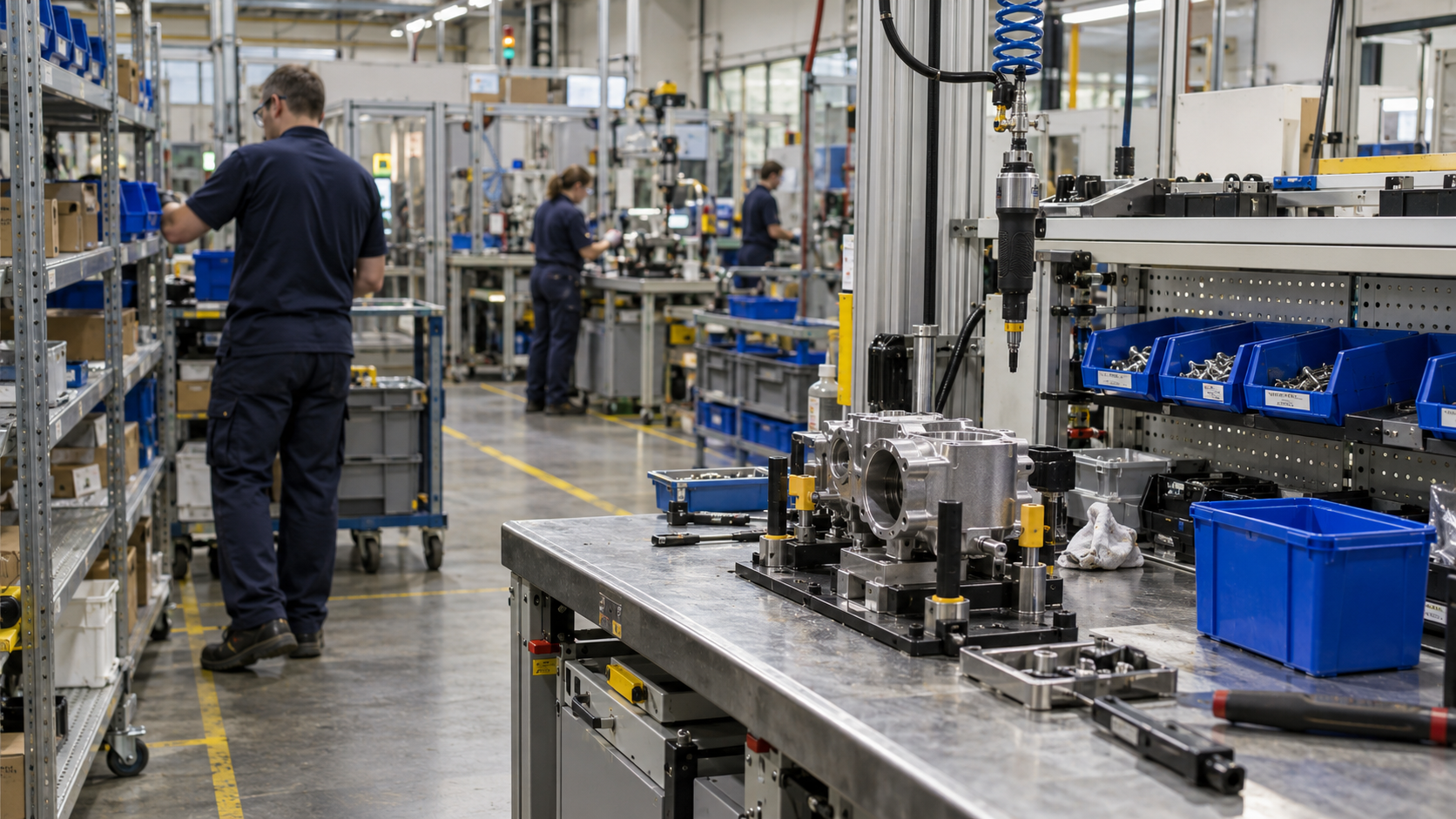
Experienced operators and supervisors bridge this gap through their knowledge of the facility. They recognise recurring bottlenecks, understand which processes work differently in practice and know where problems tend to emerge during a busy shift.
This knowledge is enormously valuable, but it is difficult to capture systematically.
An engineer conducting a time study might observe a process for several hours. A supervisor might identify a recurring issue through experience. A continuous improvement team might spend weeks investigating a particular constraint.
These approaches have been central to industrial improvement for decades. Their limitation is the amount of activity that can realistically be observed and analysed.
Computer vision offers a way to extend that visibility across more areas, shifts and processes. Combined with operational data, it could make patterns that previously depended on individual experience available to the wider organisation.
That has important implications for how industrial businesses identify and solve problems.
The relationship between safety and operational performance
Safety, productivity and quality are generally managed as separate disciplines, each with its own responsibilities and performance measures.
There are good reasons for this. Preventing injuries requires different expertise from managing production schedules or investigating quality defects.
But the underlying causes of poor performance don't always respect those organisational boundaries.
Return to the congested intersection in the distribution centre.
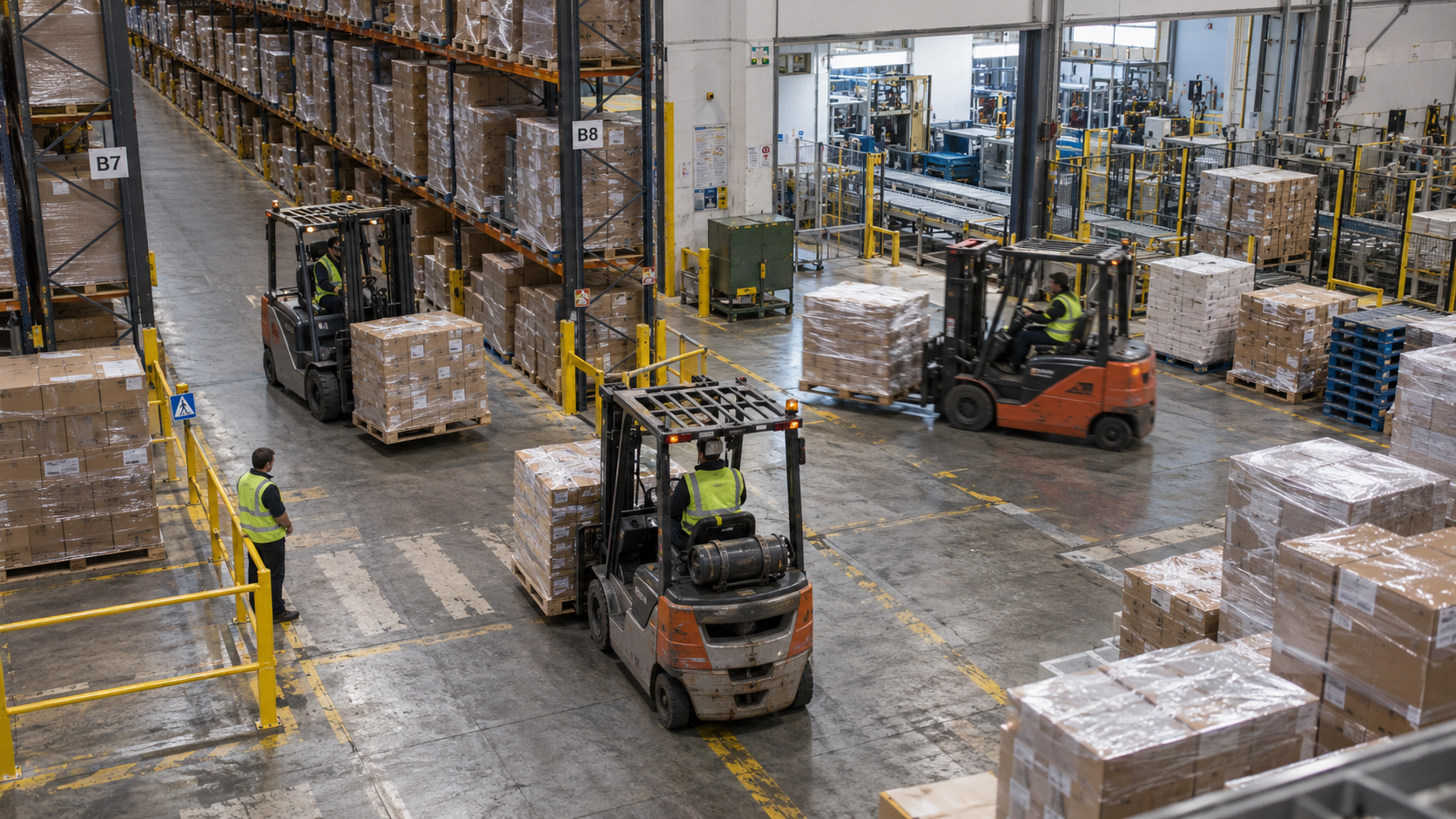
The safety team might investigate repeated near misses involving forklifts and pedestrians. Their recommendations could include additional barriers, revised pedestrian routes or changes to traffic management.
Meanwhile, operations might be investigating delays in material movement. The team could consider alternative vehicle routes, changes to scheduling or additional equipment.
Production might respond to unreliable replenishment by increasing the amount of material stored beside the line.
Each response is reasonable when considered independently. But without understanding how activity in the area is connected, there's a risk that one intervention creates problems elsewhere.
Additional barriers could restrict vehicle movement. Alternative routes could increase travel distances. More material stored beside the line could make congestion worse.
A more complete investigation might reveal that the area becomes congested during a predictable replenishment window, when several processes compete for the same space.
Changing how materials are staged or when deliveries occur could improve traffic flow, reduce risky interactions and make replenishment more reliable.
The significance of this example goes beyond the potential efficiency gains.
It illustrates how different departments can spend considerable time investigating problems that share an underlying cause.
This doesn't mean safety improvements should be evaluated primarily through their impact on productivity. Protecting people remains an objective in its own right, and some safety controls will necessarily introduce operational constraints.
But it does suggest that organisations could benefit from understanding the physical conditions contributing to multiple outcomes.
A near miss can provide useful information about traffic flow. An ergonomic risk might reveal unnecessary movement within a process. A recurring quality issue might be associated with how materials are handled or how operators interact with equipment.
These connections become easier to investigate when teams have access to a common understanding of activity on the floor.
For physical AI to be useful here, it needs to help safety and operations understand how the same conditions affect both people and performance.
What actually happens during a shift
Industrial processes are generally designed around an expected sequence of activities.
Standard operating procedures define how tasks should be performed. Engineered cycle times establish expectations for productivity. Facility layouts and material routes are designed to support efficient movement.
In practice, operations rarely follow these plans perfectly.
Equipment becomes unavailable. Deliveries arrive late. Materials are stored in unexpected locations. Production schedules change.
Operators adapt to keep work moving.
These adaptations are an important part of how industrial facilities function, although they aren't always reflected in the systems used to manage them.
An operator might develop a quicker way to complete a task. A forklift driver might regularly take a different route to avoid congestion. A team might change the order of activities because the documented process doesn't work particularly well during a busy shift.
Some adaptations create unnecessary risk. Others compensate for weaknesses in the original process. Some may represent genuine improvements that haven't been formally recognised.
Understanding the difference requires looking at the circumstances surrounding the behaviour.
Consider a workstation where operators repeatedly leave their designated area to retrieve materials.
From a process compliance perspective, this could be interpreted as a deviation from the expected workflow. But the more useful investigation might focus on why materials aren't consistently available where they're needed.
The operator's behaviour may be revealing a weakness in the process design.
This thinking has deep roots in Lean manufacturing and continuous improvement. Observing work where it happens, understanding the reasons behind variation and improving processes based on evidence are well-established principles.
The potential contribution of AI is to make that evidence available more consistently.
Rather than relying exclusively on periodic observations, teams could examine how a process behaves across hundreds of shifts, different operating conditions and multiple facilities.
They could identify which deviations occur repeatedly, understand the circumstances associated with them and investigate whether those patterns contribute to operational losses.
There's also an opportunity to learn from the differences between facilities.
Two sites might operate similar processes using comparable equipment, yet achieve very different results. Understanding the physical differences in how work is performed could help explain why.
This kind of analysis has historically required considerable time and expertise. As observation becomes more scalable, it may become practical to investigate a much broader range of processes.
Connecting physical activity with operational data
Many factories and warehouses already have extensive camera infrastructure.
Historically, most of this footage has been used for security, monitoring or investigations after an incident.
Advances in computer vision allow cameras to provide structured information about activity within a facility.
Depending on the environment and available coverage, this might include vehicle movements, pedestrian interactions, waiting times, equipment utilisation or the sequence of activities involved in a particular process.
However, observing an activity doesn't necessarily explain its significance.
A forklift waiting for several minutes might indicate congestion, but it could also be waiting for a scheduled delivery or following an established operating procedure.
Repeated observations can help establish patterns. Understanding the reasons behind those patterns requires additional context.
Consider a warehouse where forklifts regularly queue near a loading area during the afternoon.
Computer vision could establish when queues form, how long vehicles wait and whether the problem is becoming more frequent.
Warehouse management data might show that these periods coincide with a particular wave of outbound orders. Information about staffing, dock availability and material movements could provide further context.
Together, these observations could help the operations team develop and test an explanation for the delays.
The team might adjust the scheduling of material movements, change the staging layout or modify how work is allocated.
The next question would be whether the intervention actually improved performance.
Did waiting times decrease? Did material flow become more predictable? Were there fewer risky interactions between vehicles and pedestrians?
This is where the combination of physical observation and enterprise data becomes particularly useful.
Existing industrial systems already contain much of the context needed to understand an operation. Computer vision can contribute information about the physical activity that those systems don't directly observe.
The value comes from connecting the two.
That operational context is essential for physical AI. Recognising that a vehicle is waiting is useful; understanding what it is waiting for helps determine what should happen next.
There are practical limitations, of course. Camera coverage is rarely complete, and not every activity can be reliably interpreted from video. Integrating information across systems can be difficult, particularly in older facilities with fragmented technology.
Human expertise will remain essential for interpreting observations and deciding how processes should change.
But even with these limitations, a more continuous understanding of physical activity could significantly improve how teams investigate operational problems.
It could also support a wider range of applications than traditional approaches to computer vision.
Information about vehicle movement, for example, is relevant to collision prevention, traffic design, material flow and equipment utilisation.
Observations of activity around a workstation could support ergonomic assessments, cycle-time analysis and process improvement.
These applications involve different questions, but much of the underlying information is shared.
That creates an opportunity to develop software around a common understanding of the physical environment, rather than treating every use case as an entirely separate problem.
What happens when more of the facility becomes autonomous?
The need to understand activity across an entire facility becomes more important as industrial automation advances.
Factories and warehouses were largely designed around people.
Even highly automated environments depend on human judgement to coordinate activities, resolve unexpected problems and adapt when conditions change.
An experienced forklift driver understands when an aisle is becoming congested. A production supervisor recognises when increasing output in one area will create problems further downstream. Operators regularly make small adjustments that keep processes running despite imperfect conditions.
These decisions rely on an understanding of the wider environment.
As robots and autonomous systems become more common, some of these decisions will increasingly be made by software.
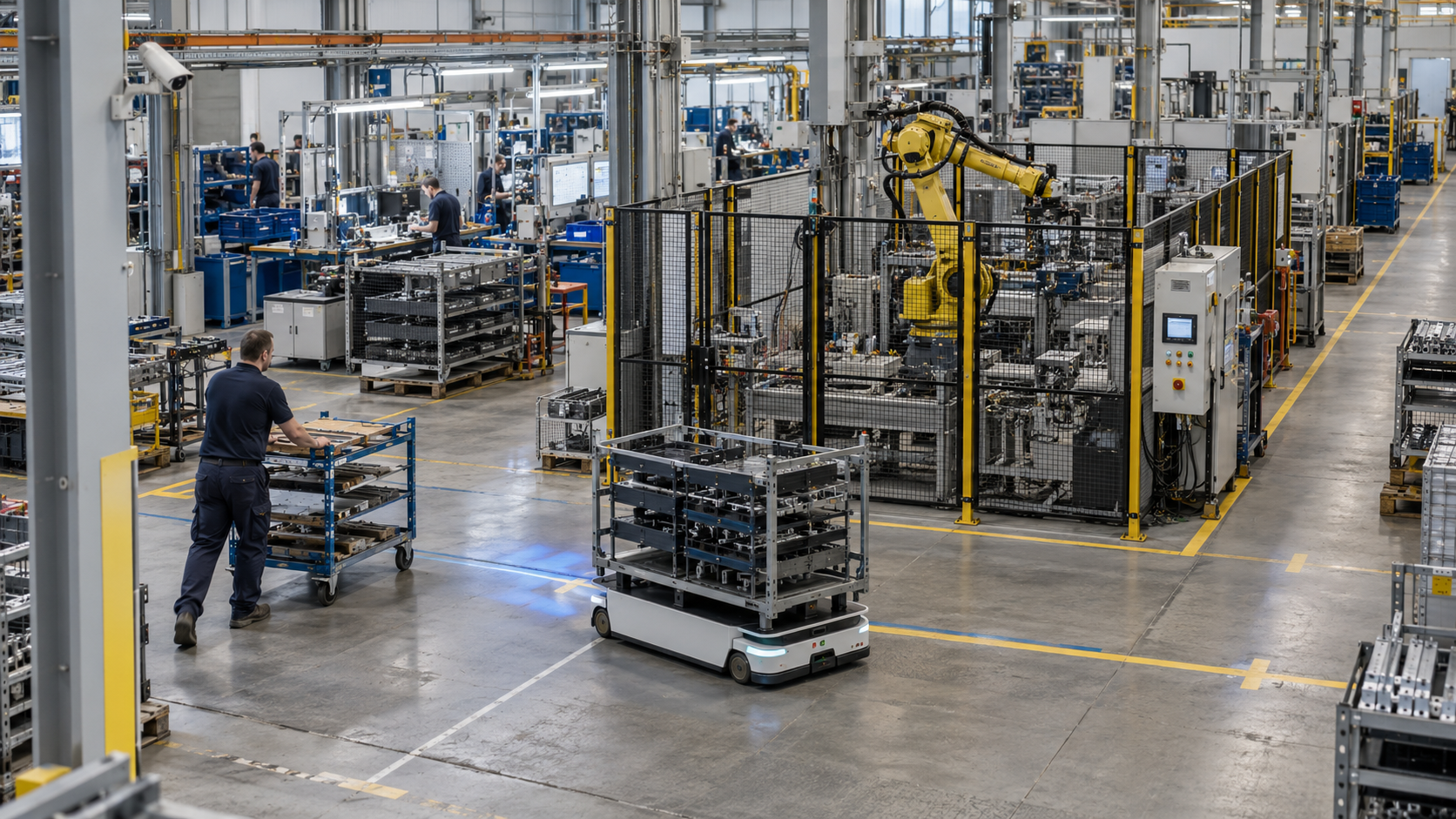
Physical AI brings perception, reasoning and action together in these systems. Their decisions need to account for the people and processes around them, as well as the task they have been assigned.
The challenge is that improving the performance of individual systems doesn't necessarily improve the performance of the facility.
An autonomous mobile robot might navigate efficiently between two locations while contributing to congestion in a shared aisle.
An automated production cell might increase output while creating a bottleneck at the next stage.
A warehouse might improve picking productivity only to discover that packing and dispatch cannot accommodate the additional volume.
These are familiar operational problems, but automation introduces new complexity.
Autonomous systems are generally designed to perform particular tasks within defined operating constraints. As more of them are deployed, their interactions with other equipment, people and workflows become increasingly important.
A facility with dozens of autonomous systems may need to coordinate decisions across multiple technologies, each with its own objectives and operating logic.
Understanding where work is accumulating, how constraints move through the operation and how one system affects another becomes essential.
This suggests that an important part of the next phase of industrial automation will involve software capable of understanding and coordinating activity across the wider facility.
Individual machines will continue to become more intelligent. But their effectiveness will increasingly depend on how well they operate within the broader physical environment.
The same information that helps people identify congestion, understand process variation and improve material flow could eventually help autonomous systems make better decisions.
This is one reason the opportunity extends beyond today's applications for computer vision.
As more decisions move from people to software, the need for reliable information about the physical environment grows.
Site Intelligence: A System of Intelligence for the Physical Economy
The developments described above point towards a new category of industrial software: Site Intelligence.
For decades, businesses have relied on systems of record to manage their operations. ERP, WMS and MES platforms provide the information needed to plan activities, coordinate resources and track performance.
More recently, AI has introduced new ways to analyse that information and automate decisions.
But industrial operations present a challenge that is less common in purely digital environments. Much of the information needed to understand what is happening has never been captured in a structured form.
A production delay might originate in an unexpected interaction between people, equipment and materials. A recurring safety risk might be associated with how traffic moves through a facility. A quality problem might emerge from an informal workaround that has become part of the normal process.
Understanding these situations requires information about the physical environment itself.
Site Intelligence brings together observations from cameras and sensors with information from enterprise systems to develop a continuous understanding of how a facility operates.
It provides the context needed to investigate operational problems, understand relationships between different activities and identify opportunities for improvement.
In this sense, Site Intelligence represents a system of intelligence for the physical economy.
The distinction matters because the physical economy operates differently from the digital environments in which much of today's enterprise software has developed.
In a digital system, activities can often be recorded directly through software. Transactions, interactions and changes in state naturally produce data.
In a factory or warehouse, important activities happen outside software. People move materials, machines interact, equipment waits and operators adapt to changing conditions.
These activities influence performance, but they don't necessarily create a digital record.
Advances in computer vision and AI are making it increasingly practical to capture and interpret that information.
Once connected with existing operational systems, it becomes possible to develop a richer understanding of how work happens across an entire facility.
This has implications for the applications businesses can build.
A safety team might investigate the conditions contributing to recurring near misses. Operations might use the same underlying information to understand traffic patterns and material movement. Production might examine how those activities affect replenishment and throughput.
The applications differ, but they can draw on a shared understanding of the physical operation.
Over time, that foundation could support a growing range of applications across safety, productivity, quality, security and operational performance.
It could also provide essential context for AI agents and autonomous systems.
An agent investigating a production delay needs to understand the relationships between equipment availability, material movements and the production schedule. An autonomous system coordinating vehicle movements needs information about congestion, pedestrian activity and the behaviour of other machines.
The more responsibility these systems assume, the more important their understanding of the physical environment becomes.
Site Intelligence provides a foundation for developing that understanding, connecting the information businesses already have with the physical activity that has historically been difficult to observe.
As physical AI takes on more responsibility within facilities, Site Intelligence could provide the shared operational context that helps people, AI agents and autonomous machines work together.
Building Site Intelligence at Protex AI
Protex AI is building the Site Intelligence platform for physical operations.
The platform transforms existing camera infrastructure into a source of operational intelligence, connects those observations with sensors and enterprise systems, and enables applications and AI agents to help businesses understand and improve how their facilities operate.
The starting point is solving problems that industrial businesses face every day.
Preventing workplace incidents. Understanding congestion and material flow. Identifying process inefficiencies. Improving how people, vehicles and equipment interact.
These applications address different operational priorities, but they share a common foundation.
Information collected to understand vehicle interactions can also support traffic analysis and material-flow optimisation. Observations of activity around a workstation can inform ergonomic assessments, process consistency and productivity improvements.
As more applications are introduced, the platform can develop a richer understanding of the facility and support a broader range of operational decisions.
This approach is particularly relevant in industrial environments, where deploying new technology can be expensive and disruptive.
Most large facilities already have extensive camera infrastructure and established enterprise systems. Building on those investments provides a practical path towards greater operational visibility without requiring organisations to replace the technology they already depend on.
The longer-term opportunity is to make Site Intelligence part of how industrial facilities are managed.
Site leaders should be able to understand where work is accumulating, why processes are underperforming and which conditions are contributing to recurring safety risks.
Engineers should be able to investigate how processes actually operate across different shifts and facilities.
As AI agents become more capable, they should be able to use that understanding to support investigations, recommend improvements and coordinate actions within the constraints of the physical environment.
This gives Protex AI a role in the adoption of physical AI: helping businesses establish the understanding of their facilities that increasingly autonomous operations will depend on.
Achieving this requires solving difficult technical and operational problems. Industrial environments are complex, existing systems are fragmented and the reliability of AI-driven insights matters enormously when decisions affect physical operations.
But the direction is becoming clearer.
Industrial businesses have spent decades investing in technology that helps them plan, coordinate and measure their operations. AI is creating an opportunity to extend that understanding into the physical environments where work actually happens.
As factories and warehouses become more automated, this capability will become increasingly important.
Protex AI is building the system of intelligence for the physical economy, giving industrial businesses the understanding they need to operate safer, more productive and increasingly autonomous facilities.
Check Out Our Industry
Leading Blog Content
EHSQ industry insights, 3rd Gen EHSQ AI-powered technology opinions & company updates.
Related content

SOP Adherence: How to Measure If Work Is Performed as Designed

How to Reduce Repeat Downtime by Combining MES Data With Video Evidence