
.jpg)
Process audits fall short when a scheduled inspection has to stand in for a moving operation. The floor changes by shift, volume, crew, supervisor, dock pressure, and route. A site can pass every formal audit and still carry risk in the hours nobody reviewed.
In this article:
- Why scheduled audits miss SOP drift, near misses, and cross-shift variance.
- How signals such as forklift overlap, blocked routes, and congestion reveal larger process gaps.
- How time-stamped event records support CAPA owners, audit prep, and post-fix verification.
- What a privacy-safe Protex deployment looks like across existing cameras, edge processing, anonymized clips, and cloud dashboards.
What Is Site Intelligence for Safer Operations?
Site intelligence gives teams privacy-preserving visibility across configured cameras, zones, and shifts. In this article, continuous observation means the same practical workflow: turning existing cameras and site signals into event data, anonymized clips, heatmaps, reports, focus lists, and recommended actions.
For EHS teams, that means earlier visibility into leading indicators. For Operations, it shows where process drift, congestion, or layout friction affects flow, throughput, and standard work. The need is especially clear in warehouses, manufacturing sites, and distribution environments, where activity changes hour by hour.
5 Reasons Process Audits Fail
Many safety and process compliance programs look strong on paper. The breakdown is usually structural, not intentional.
A process audit samples part of the day. The operation keeps moving after the auditor leaves.
1. Limited Observation Windows Create Sampling Bias
A facility running three shifts might only be reviewed during the morning run. That leaves evening, night, weekend, peak-volume, and shift-change conditions outside the sample.
That matters because risk rarely spreads evenly across the day. A dock may look clear during a quiet walk-through, then become congested when outbound volume rises. A route may appear compliant during one shift and drift during another.
2. People Change Their Behavior During Audits
Teams tend to tighten up when a visitor is present. That is human.
The issue is not that workers are trying to hide risk. The issue is that scheduled observation can change the conditions being observed.
Teams may follow every documented step during the walk-through, then return to informal shortcuts once production pressure returns.
3. Checklists Confirm Existence, Not Consistency
A checklist can confirm that a procedure exists. It cannot show how reliably the procedure holds up under pressure.
That gap matters for process compliance. Standard work may look clear in documentation, but break down when a bay is short-staffed, a forklift is covering two zones, or materials are staged in the wrong area.
4. Corrective Actions Age Between Audit Cycles
Audit findings often create corrective and preventive actions. The problem comes after assignment.
A status field might show that the action is complete. The floor may tell a different story. Without ongoing evidence, teams struggle to confirm that the fix changed what happens during real work.
5. Cross-Shift Variance Stays Hidden
A Tuesday morning audit tells you very little about Friday night execution.
Shift-level variance can show up in route adherence, PPE use, traffic separation, housekeeping, area control, and equipment patterns. Point-in-time reviews cannot compare every crew against the same standard.
What Audits Miss Between Visits
The problem rarely comes down to auditor quality. It comes down to applying point-in-time observation to a process that never pauses.
Between visits, SOP adherence shifts with crew composition, supervisor presence, work volume, asset availability, and layout pressure. A procedure that looks clean during a quiet morning can break down during a peak-load afternoon.
No checklist captures that variance if no one was there to see it.
Small Signals That Point to Bigger Patterns
Recurring close calls often start as small signals: pedestrian and forklift overlap, blocked routes, rushed loading activity, poor area control, or the same workaround repeating in one zone. These signals may never become formal reports. They still point to risk.
The same pattern affects Operations. Congestion, route deviation, and underused space can slow flow before anyone labels it a safety issue. Facility flow and layout insights help teams see where movement patterns create both operational friction and safety exposure.
Shift Variance and Crew Composition
Process execution changes depending on the people, supervisor, volume, and conditions on the floor. One inspection window captures one version of the operation.
Cross-shift consistency needs a wider evidence base. Teams need to compare covered zones, time periods, and crews against the same operating standard.
Near-Miss Patterns Hidden in Plain Sight
Near misses often cluster in specific zones or conditions. A blind corner. A congested U-path. A loading bay that gets overloaded during shift change.
Without continuous data, these patterns stay anecdotal. With event data and visual context, teams can compare near misses by zone, shift, time, and process condition.
How Site Intelligence Changes Visibility
Site intelligence gives teams a stronger operating loop:
Observe. Detect. Review. Assign. Verify.
Configured detections and event records help teams see process gaps across covered shifts and zones, rather than one scheduled audit window. Protex Intelligence supports that loop by helping teams ask questions in plain language, generate reports, compare sites and shifts, identify hotspots, and create focus lists for supervisors.
EHS teams stop working from a static snapshot. Operations teams gain a clearer view of where process drift affects flow, downtime, and standard work.
Audit Evidence Becomes Continuous
In an Amazon evaluation context, Protex supported a projection of 10,000+ annual site-level audit hours saved. That is not a guaranteed result for every deployment, but it shows how much manual audit and reporting work can sit inside periodic programs.
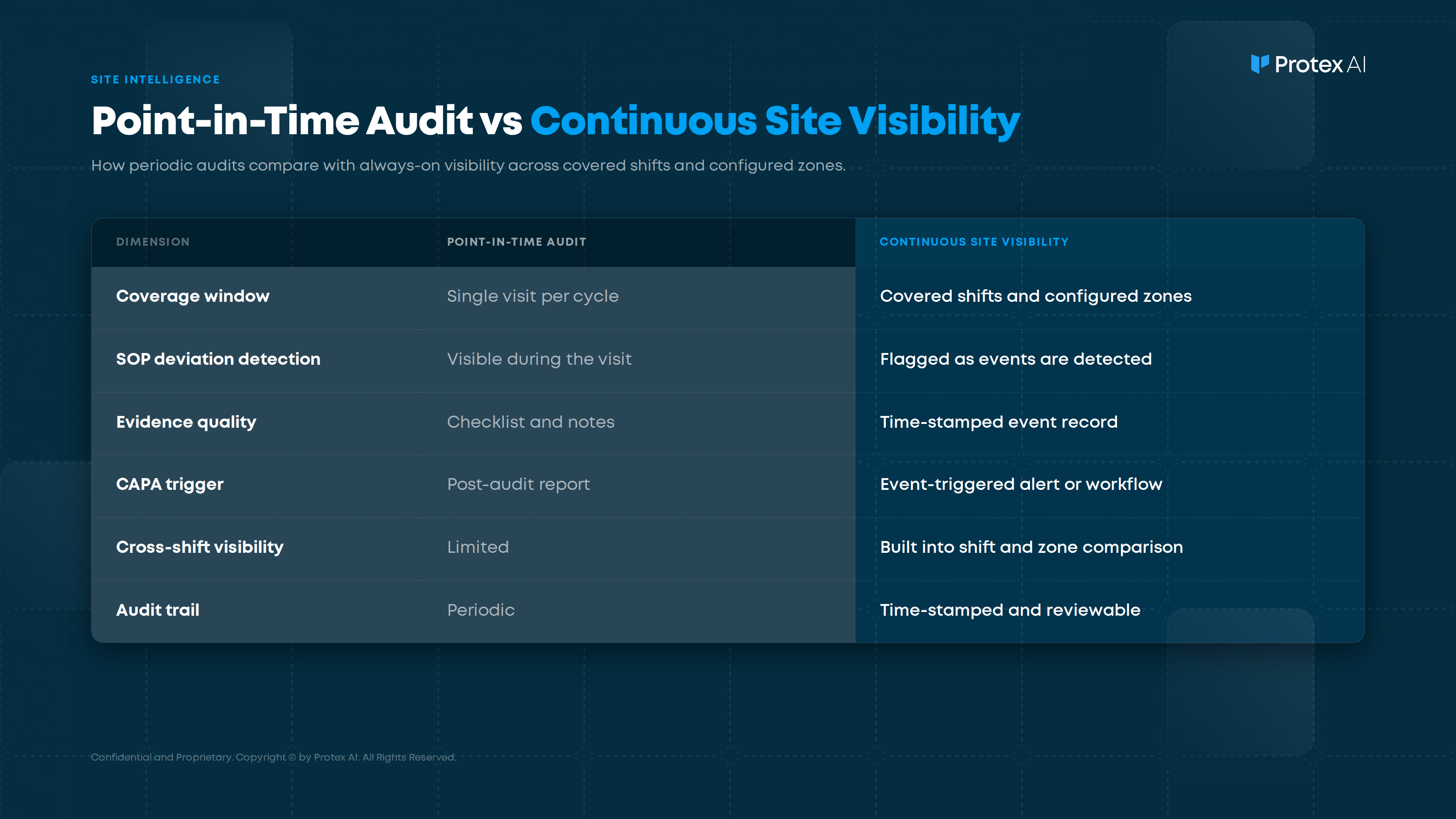
Timing is the practical difference. A post-audit report describes something that already happened. An event-triggered workflow can flag a pattern while there is still time to intervene.
Alerts vs. Retrospective Findings
A standard audit finding might describe an issue from weeks ago. Event-triggered alerts bring the issue closer to the moment it happened.
That gives supervisors a better chance to act before the same pattern repeats. Reporting workflows also give each action a place to live, with owners, reports, and follow-up tied to the event record.
Visual Evidence and Root Cause Clarity
Anonymized clips and heatmaps do more than confirm that a process drifted. They show where, when, and under what conditions the issue appeared.
That context matters for root cause analysis. A note might say “route not followed.” A short, anonymized clip can show that the planned route was blocked, the alternative path was shorter, or a staging issue forced the team into a workaround.
Multi-Site Consistency
Continuous visibility helps leaders compare SOP adherence across sites, shifts, zones, and teams. That makes it easier to see where support is needed and where one site’s fix could apply across the network.
Teams can then measure if repeat findings decline and if corrective actions close faster after an intervention.
Turn Observations Into Stronger Corrective Action
Detection is only half the work. The real value comes when the observation turns into a clear action.
A defensible evidence trail connects the observed deviation to an owner, action, follow-up, and verification. That is stronger than a note in a spreadsheet because the team can review the event record and the surrounding conditions.
Site intelligence works best when it feeds the systems and routines teams already use: huddles, audit prep, CAPA reviews, safety meetings, operations reviews, and leadership reports.
Evidence Makes the Business Case Easier to Defend
A Protex case study shows how a major UK packaging manufacturer used time-stamped documentation to support operational change, unlock £750K in funding, and report a 62% reduction in safety incidents. That result reflects a specific customer context, but it shows how visual proof can support both safety and operational business cases.
Assigning Clear Corrective Action Owners
Findings tied to a time-stamped event are easier to assign because the issue is specific. The action owner can see the zone, condition, and pattern behind the finding.
That changes the conversation. Instead of debating a manual note, the team can discuss what caused the drift and what change would prevent recurrence.
Verifying Follow-Through After the Fix
A completed action is not the same as a changed process.
Periodic reviews often confirm that someone updated the status field. Continuous site visibility can help teams check if the target condition actually changed in covered zones after the fix.
That makes the Corrective and Preventive Action (CAPA) loop more practical: assign the action, make the change, then verify the pattern.
What a Privacy-Safe Deployment Looks Like
Worker privacy is a valid concern. It needs a direct answer, especially when cameras and configurable AI detections are part of the conversation.
Protex is built as privacy-preserving Industrial AI for site intelligence. It helps teams identify site signals, process patterns, operational risk, and safety conditions without scoring individual people.
A privacy-safe deployment should include:
- Existing camera infrastructure - Protex works with current site cameras, so teams do not need to start with a disruptive hardware replacement project.
- Edge processing - Event detection, blurring, and encryption happen locally on edge devices.
- No raw CCTV streaming off-site - Raw CCTV footage does not stream to the cloud for analysis.
- Anonymized clips and metadata - Relevant events become anonymized clips and metadata before they appear in cloud dashboards.
- Configured zones and rules - Teams define the areas and signals that matter for safety, process execution, and operational improvement.
- Transparent workforce communication - Frontline teams need to know the purpose: improving site conditions, reducing risk, strengthening coaching, and supporting better decisions.
Protex’s enterprise and privacy architecture supports IT review, data governance, and frontline trust.
Common Questions About Process Audits and Site Intelligence
Why Do Process Audits Miss Issues?
Process audits miss issues because they sample a narrow part of a changing operation. Behavior can shift during a scheduled review, and the report often arrives after the process has already moved on.
What Is Site Intelligence for Process Audits?
Site intelligence gives teams privacy-preserving visibility into process execution across covered cameras, configured zones, and selected event types. EHS teams can see leading indicators earlier, while Operations teams can identify process drift, congestion, and shift-level variance with stronger evidence.
How Do You Reduce Audit Blind Spots?
Pair scheduled audits with ongoing site intelligence. Audits still matter, but continuous site visibility helps teams compare patterns by zone, shift, site, and rule.
How Do You Prove Follow-Through After an Audit?
Use a time-stamped event trail. A corrective action backed by observed before-and-after patterns gives teams clearer proof than a manual status update alone.
Make the Time Between Audits Visible
Process audits still have value. They set expectations, document controls, and keep teams accountable.
They fail when they are treated as the full picture.
Industrial sites create signals all day: near misses, route drift, congestion, blocked areas, repeated workarounds, and changing risk patterns. Protex AI turns those signals into site intelligence so EHS, Operations, IT, and leadership teams can see what is happening, identify why it matters, and act with better evidence.
The goal is not to replace the audit. See Protex AI in action and help your team make the time between audits visible.
Check Out Our Industry
Leading Blog Content
EHSQ industry insights, 3rd Gen EHSQ AI-powered technology opinions & company updates.
.jpg)
.avif)
.avif)