Site leaders now have plenty of choice in AI workplace safety software. The six platforms in this guide differ most on four points: the hardware they need, how they handle privacy, the teams they are built for, and how far they reach beyond safety into operations.
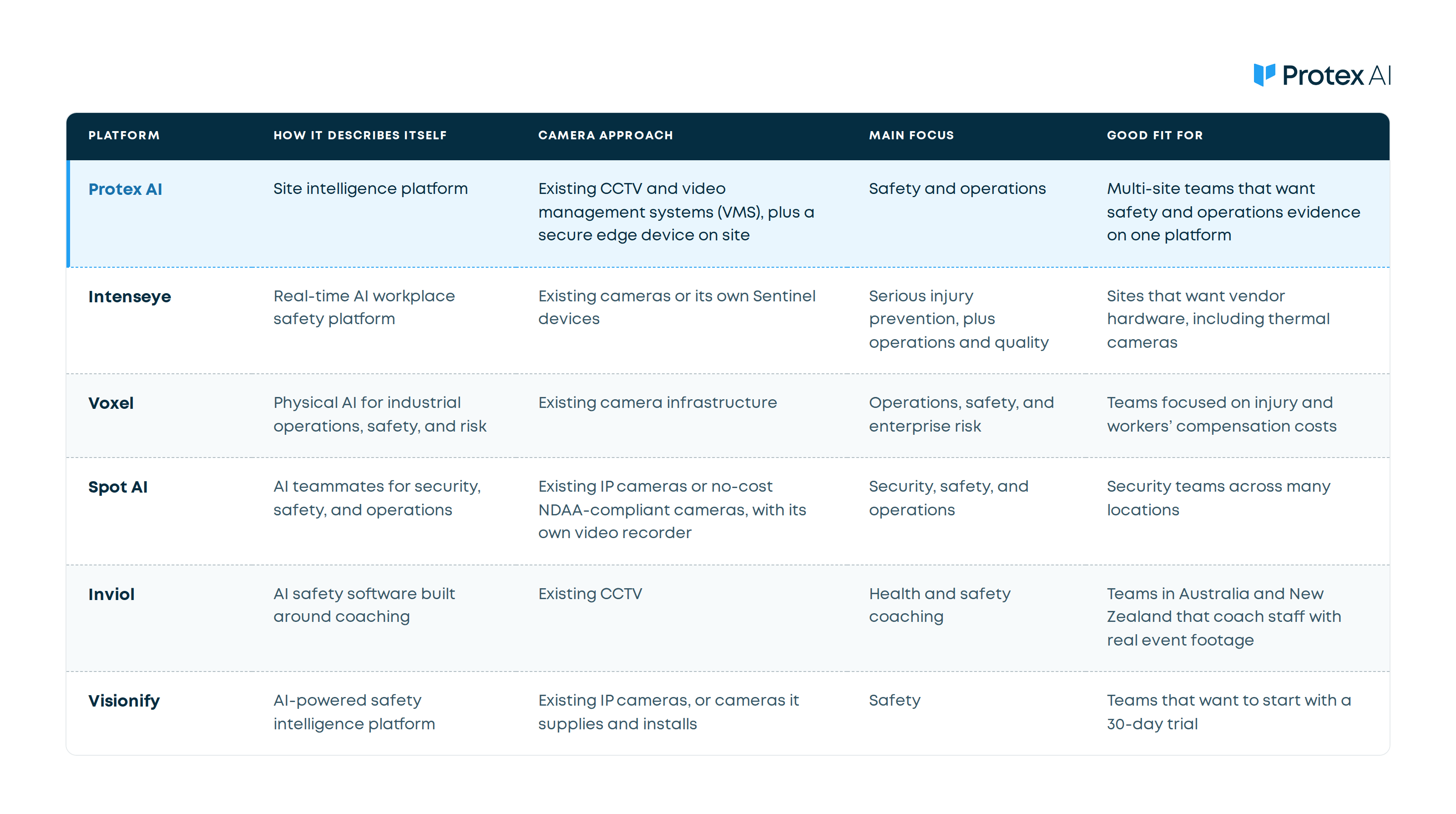
Protex AI is a good fit for multi-site manufacturing, logistics, and distribution teams who want safety and operations evidence from their existing CCTV in one platform. It was the top-scoring vendor in the 2026 Verdantix Smart Innovators report on video analytics for safety, and Bendix saw an 84% reduction in targeted behaviors within 60 days.
Intenseye, Voxel, Spot AI, Inviol, and Visionify suit more specific needs:
- Intenseye: Sites that want the vendor to supply cameras, sensors, and other hardware
- Voxel: Teams focused on injury and workers' compensation costs
- Spot AI: Security teams
- Inviol: Teams in Australia and New Zealand that use safety events to coach staff
- Visionify: Teams that want a free trial before buying
This article covers:
- What a site intelligence platform does, and how it differs from environment, health, and safety (EHS) software and video security
- The six platforms compared side by side
- Seven questions to ask every vendor before a pilot
- Answers to common buyer questions on deployment time and pricing
What Is an Industrial Site Intelligence Platform?
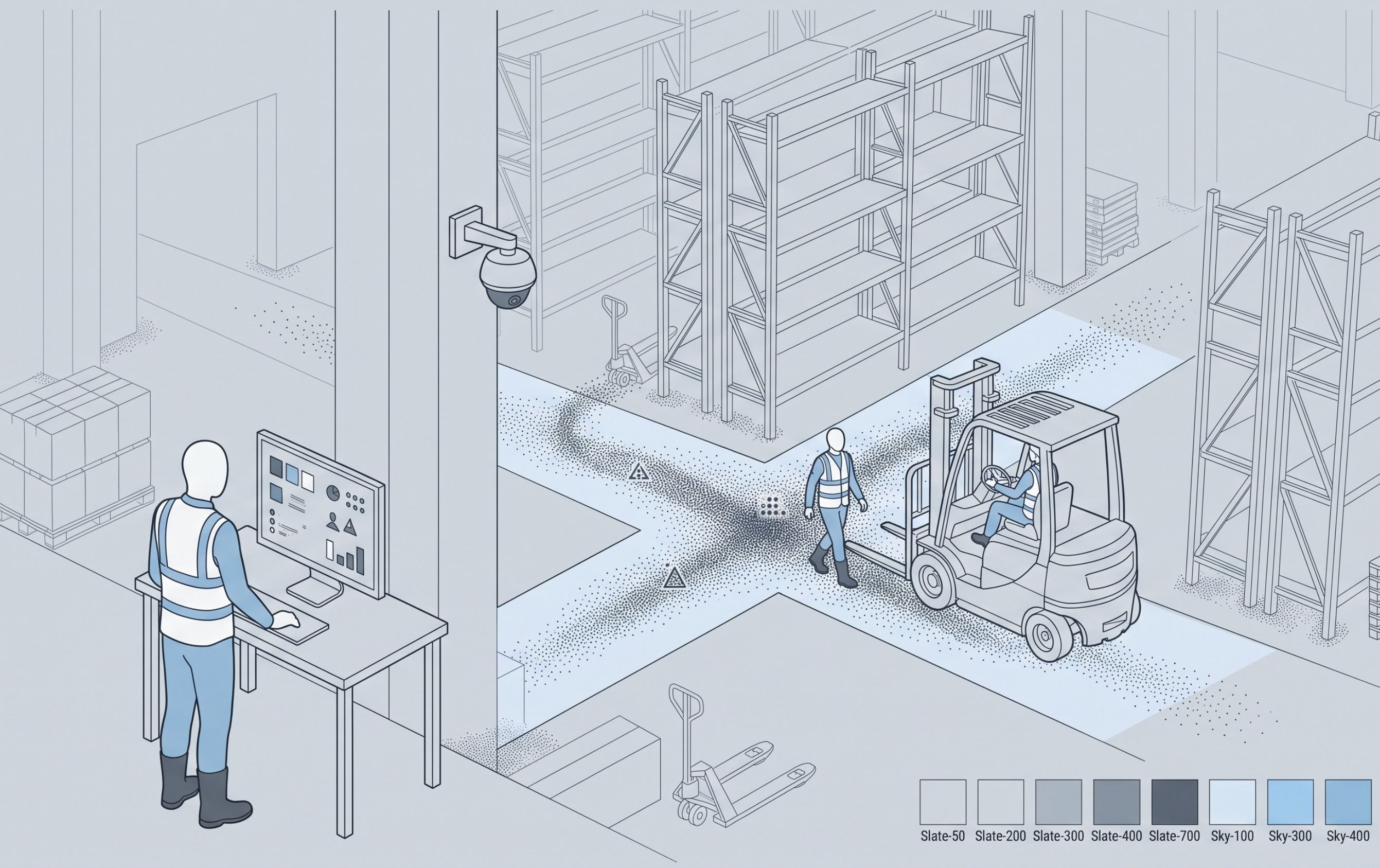
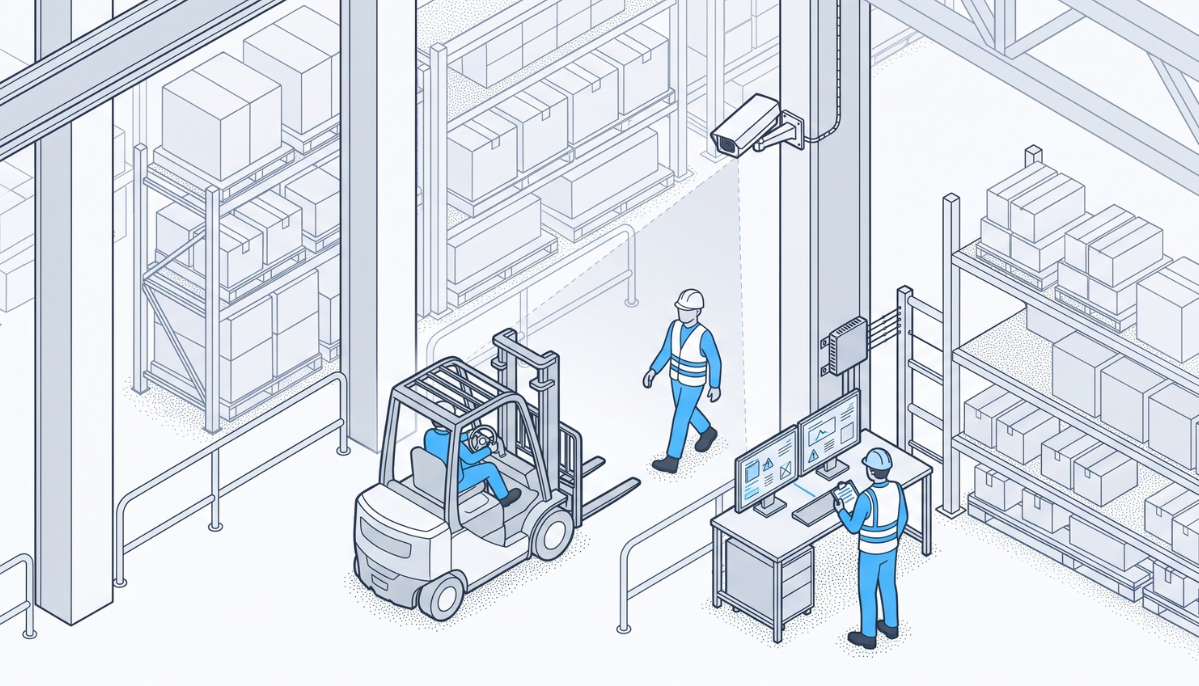
An Industrial site intelligence platform applies computer vision to a site's existing cameras and combines what it sees with operational and safety data. The result is a continuous picture of risk, movement, and flow that EHS, operations, and site leaders can all act on.
Buyers often weigh four product categories that solve different problems:
- EHS software
The system of record for incidents, audits, corrective actions, and training. It records each item and tracks it through a workflow until it is closed.
- Safety computer vision
Turns camera footage into safety events such as vehicle and pedestrian interactions, missing personal protective equipment (PPE), or blocked walkways, so EHS teams see leading indicators instead of waiting for an incident report.
- Site intelligence platforms
Use AI to combine camera detections with operational and business data. One deployment often serves safety and operations goals such as facility flow and process compliance.
- Video security systems
Record and store footage and respond to security events. Some now have computer vision capabilities for safety- and operation-specific detections.
The 6 Platforms at a Glance
Comparison Criteria
The seven criteria below apply to every vendor, Protex AI included.
- Proven outcomes - Named customers, with concrete data and timeframes.
- User control over data - Who sets and changes detection rules and settings after go-live
- Alert relevance - How the platform keeps alerts relevant to real site conditions.
- Deployment and infrastructure - Fit with existing CCTV, plus any hardware the vendor adds on site.
- Privacy and security - Where video is processed, what reaches the cloud, and which privacy controls can be configured to match internal policy and workforce agreements.
- Safety and operations coverage - The extent to which the same cameras can serve operations as well as EHS teams.
- Integrations and scale - Connections to EHS, business intelligence (BI), warehouse management (WMS), manufacturing execution (MES), and programmable logic controller (PLC) systems, and management across many sites.
1. Protex AI
Protex AI is a site intelligence platform that fuses existing CCTV with operational and safety data to create a real-time picture of physical operations. EHS and operations teams use it to spot risk hotspots, flow problems, bottlenecks, and other production issues across shifts and sites, then turn them into investigations and corrective actions. Protex AI reports deployments in Fortune 500 environments across 28 countries.
- Safety and operations on one platform
The same cameras and edge device run Protex’s AI workplace safety software for vehicle control, PPE, ergonomics, and housekeeping. They also feed operations intelligence on facility flow, throughput, and process compliance.
- Alerts that reflect site context
Teams adjust zones, thresholds, dwell times, and object sensitivity through visual interfaces. Rules can also draw on shift schedules, permit status, or machine state to decide if a detection needs action. During the first 60 days, Protex refines its models for each site's conditions to reduce false positives.
Context filters set at the rule level remove events that are technically correct but not relevant to that site. This cuts alert noise and helps to reduce alert fatigue.
- Named customer results
Bendix Commercial Vehicle Systems saw an 84% reduction in targeted behaviors within 60 days. Protex data also showed a work cell repeatedly striking racks. That evidence helped Bendix justify a fix that recovered an estimated 226 labor hours a month.
Marks and Spencer reduced overall incidents by 80% within the first 10 weeks, and Dot Foods recorded a 39% reduction in overall safety events at its hub distribution center.
AB Agri reported a 91% decrease in defined workplace transport learning opportunities and a 99% reduction in measured PPE non-compliance incidents.
- Analyst recognition
Protex AI was the top-scoring vendor of the 10 video analytics providers evaluated in the 2026 Verdantix Smart Innovators report.
- Privacy controls set per deployment
An edge device on site processes video locally. Anonymization, facial blurring, full-body blurring, ghosting, and videoless operation are all customizable to each organization's policies, legal requirements, and workforce agreements. Protex holds ISO/IEC 27001:2022 certification, audited annually.
It also lists GDPR, UK DPA, and CCPA compliance, alignment with the EU AI Act, and a CSA STAR Level 1 self-assessment. The full approach is on the enterprise privacy and security page.
- Connected to the systems teams already use
Protex connects to EHS, BI, WMS, MES, and enterprise resource planning (ERP) systems, plus PLCs and safety hardware. Protex Intelligence lets teams ask questions of their site data in plain language and export the answers as customizable reports.
- What deployment requires
Protex runs on cameras already in place, with a secure edge device on site that connects to existing CCTV and video management systems (VMS). Bring IT into planning early, since the device sits on the site network. Results also depend on camera coverage and on a regular routine for reviewing and acting on findings.
- Good fit for: Multi-site manufacturers, logistics and distribution teams who want safety and operations evidence from their existing CCTV in one platform, with privacy controls set to their own policies.
- Less direct fit when: The main need is video security, recording, or theft deterrence, or a team wants a standalone EHS system of record. Protex works as the intelligence layer on top of the EHS system a site already uses.
2. Intenseye
Intenseye describes itself as a real-time AI workplace safety platform that runs computer vision on existing cameras or on its own Sentinel devices. It says it detects more than 50 types of high-risk hazards and frames its program around preventing serious injuries and fatalities.
Beyond safety, it lists operations workflows such as pathway analysis, asset use, and cycle time, plus quality checks such as hygiene and cold-chain monitoring.
The Sentinel line includes cameras, edge compute hubs, thermal and depth sensors, speakers, and signal towers. Intenseye also offers Hard Stop for machine-stop integration and Chief, an AI safety copilot. It reports more than 400 facilities live across 45+ countries and lists SOC 2 Type II.
- Good fit for: Sites that would rather pay for hardware as a subscription than make an upfront infrastructure investment, which Intenseye says it offers. Intenseye supplies cameras, sensors, and other hardware such as thermal cameras for heat and electrical hazards, alongside or in place of existing CCTV.
- Less direct fit when: Operations leaders want to run the program. Intenseye leads with serious injury prevention and offers operations and quality as added solutions.
3. Voxel
Voxel describes itself as physical AI for industrial operations, safety, and risk, built on existing camera infrastructure. It says it can deploy to a site in 48 hours using a hybrid cloud architecture.
Voxel pairs its software with certified experts in safety, risk, and operations. Its solution pages speak to operations, safety, and enterprise risk teams, and its customer stories report results such as lower injury costs and workers' compensation costs.
- Good fit for: Teams focused on injury and workers' compensation costs that want certified safety and risk experts alongside the software.
- Less direct fit when: A company wants all video to stay on site and out of the cloud. Voxel says its processing runs in the cloud, with no edge device on site.
4. Spot AI
Spot AI says it turns the cameras a business already has into AI teammates that act across security, safety, and operations. Its system pairs existing IP cameras, or NDAA-compliant cameras it offers at no cost, with its own Intelligent Video Recorder for on-edge AI and 24/7 local storage, plus a cloud dashboard.
Spot AI also offers an AI security guard for live deterrence and Iris, a conversational agent it says lets teams ask any camera a question in plain language. Its industry pages cover manufacturing and warehousing, construction, retail, car washes, healthcare, and education.
- Good fit for: Security teams that want to modernize recording and add live deterrence and AI across many locations.
- Less direct fit when: A site wants to add AI to its current video management system and recorder. Spot AI works with existing IP cameras but brings its own Intelligent Video Recorder, an on-site box that stores the footage and runs the AI.
5. Inviol
Inviol describes itself as AI safety software that uses real events to coach safer teams. It plugs into existing CCTV, turns detected events into short coaching clips, and builds toolbox and training sessions from them.
Inviol says it processes footage on site so that "99% of your data never leaves site", with automated people and face blurring. It was founded in New Zealand and lists offices in New Zealand and Australia.
- Good fit for: Teams in Australia and New Zealand that want a local vendor and a simple tool that turns safety events into coaching clips for yards, branches, and depots.
- Less direct fit when: The program needs to answer operations questions as well as safety ones, since Inviol presents itself as health and safety software.
6. Visionify
Visionify describes itself as an AI-powered safety intelligence platform. It offers more than 50 pre-built safety events on existing IP cameras, runs on site with faces blurred, and says a first site can go live in a week. It can also supply and install cameras.
Its Starter Kit is a free 30-day trial on a team's own cameras with a pre-configured edge server. Visionify says its Ergovision tool produces REBA and RULA ergonomic assessments from a two-minute phone video.
- Good fit for: Teams that want to test the software free before committing, or standalone ergonomic assessments from phone video.
- Less direct fit when: A program wants the same deployment to serve operations teams as well as EHS, since Visionify positions itself on safety.
7 Questions to Ask Every Vendor
These questions apply to Protex AI too:
- What specific results have named customers seen, and how quickly?
- Who changes the rules and settings for computer vision detection after go-live, and how long does a change take?
- What hardware do you add on site, and how much bandwidth does each camera need?
- What leaves the site: raw video, event clips, event data, or only summary results?
- How do you measure alert relevancy and prevent alert fatigue?
- Which of our systems, such as EHS, BI, WMS, MES, or PLCs, do you integrate with today?
- Can the same deployment serve operations teams as well as EHS?
IT reviewers can go further with these questions IT should ask before a pilot.
Common Questions About AI Site Intelligence Platforms
How Long Does Deployment Take?
Deployment time depends on camera readiness, network access, and IT review. Vendors publish their own timeframes, so compare them on the same basis, from signed contract to first useful findings.
How Are AI Workplace Safety Platforms Priced?
Pricing models vary. Some vendors publish a per-camera subscription, and some add a one-off charge for edge hardware. Compare total cost over the contract, including edge devices or other hardware, integration work, onboarding, and support.
See How Protex AI Fits Each Site
If safety and operations teams both have a stake in the decision, the next step is to see the platform on real site footage and test it against the vendor questions above. See Protex AI in action, then take the same questions to every vendor on the shortlist.
Competitor details are based on each vendor's own website as of October 2026. Features change often, so confirm current details with each vendor. Protex AI will correct any inaccuracy reported to it.
Check Out Our Industry
Leading Blog Content
EHSQ industry insights, 3rd Gen EHSQ AI-powered technology opinions & company updates.