

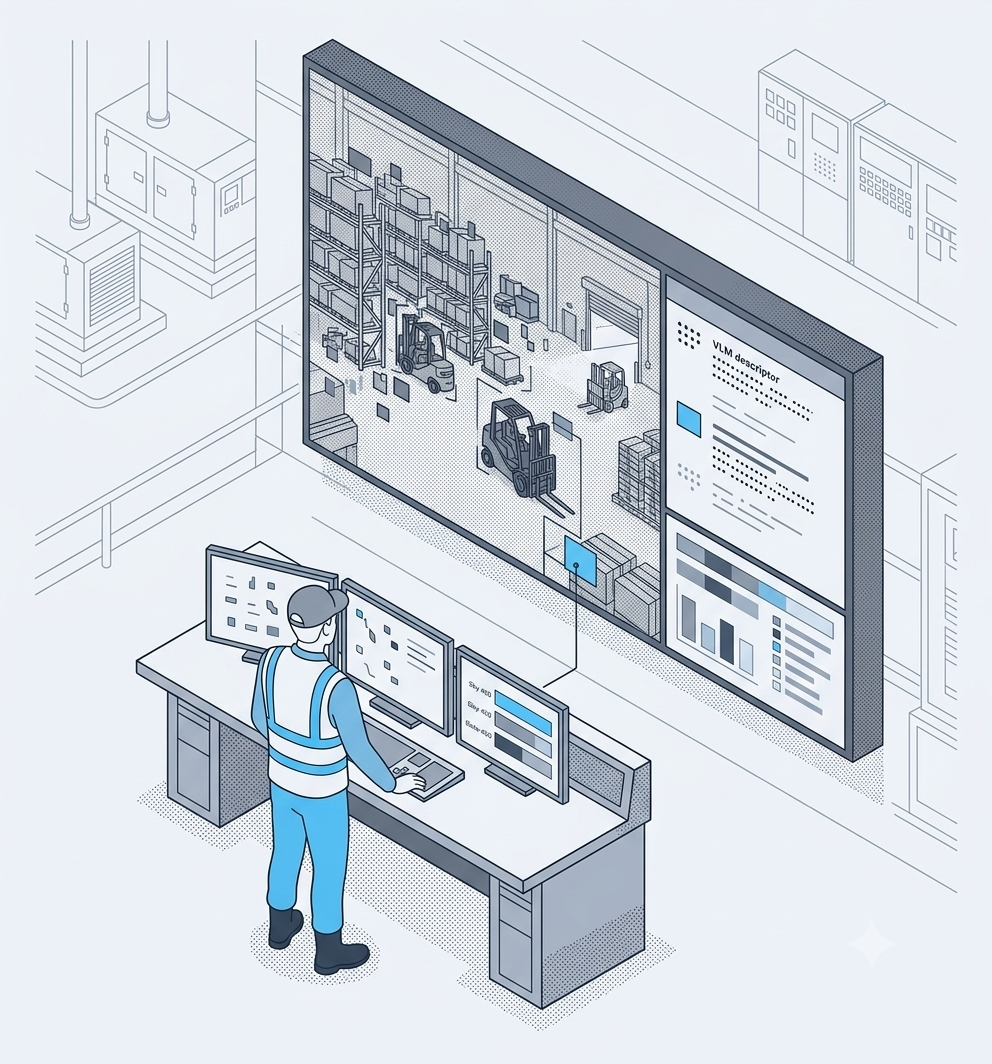
Computer vision (CV) is becoming the status quo on active manufacturing and logistics sites. Cameras flag hazards, log events, and build a record of what happens on the floor. The industry spent a decade teaching computer vision to detect reliably, and it worked.
The harder problem is what happens when it works too well: a system producing hundreds of alerts a shift, most of which don't need a response, trains people to stop looking. And a system people stop looking at stops being useful, however accurate it is.
This isn't a futuristic roadmap. It’s how we’re bringing the most critical insights to the front. Everything below is running on live in Protex AI sites today, helping teams cut through the noise:
- Operational data integrations: connecting your scheduling, maintenance and shift data so that your alerts are based on the context sites already know
- Contextual filters: filtering detections for urgency before they reach the queue with Plain-English conditions
- VLM descriptors: a written scene description for every event, making the entire operation searchable
- Severity ranking: Surfacing the highest-risk events first so that critical issues don’t get buried
Operational data and CV shouldn't live in silos
A crew in a restricted area without high-vis could be a risk, or it could be the maintenance team on a planned walk-through during downtime. A drop in throughput at the end of the line looks like a problem. It's also a changeover that's been in the schedule all week.
Computer vision can't tell the difference. And no amount of fine-tuning the accuracy changes that, because the context that resolves the ambiguity isn't in the frame. It's in your scheduling system, your maintenance log, and your shift plan.
Protex AI integrates directly with that data. When an event fires, Protex Intelligence considers what the site already knows is happening. A vest alert during a planned maintenance window doesn't reach the event queue. A pedestrian near-miss during a normal working hours does. The question each event has to answer isn't just "was there a detection?" It's "given what was scheduled on the site, does this actually matter?"
Avoiding alert fatigue
The most powerful way to reduce noise? Avoid creating it in the first place.
We shipped contextual filters. We can now attach a prompt to any rule. In plain English. A few examples from live deployments:
"Only alert if the forklift is carrying a load." "Ignore if the person is the dock supervisor in the green vest." "Flag this only when the vehicle is reversing." "Only show PPE violations if the worker is standing at the machine." "Do not alert during the night-shift cleaning window."
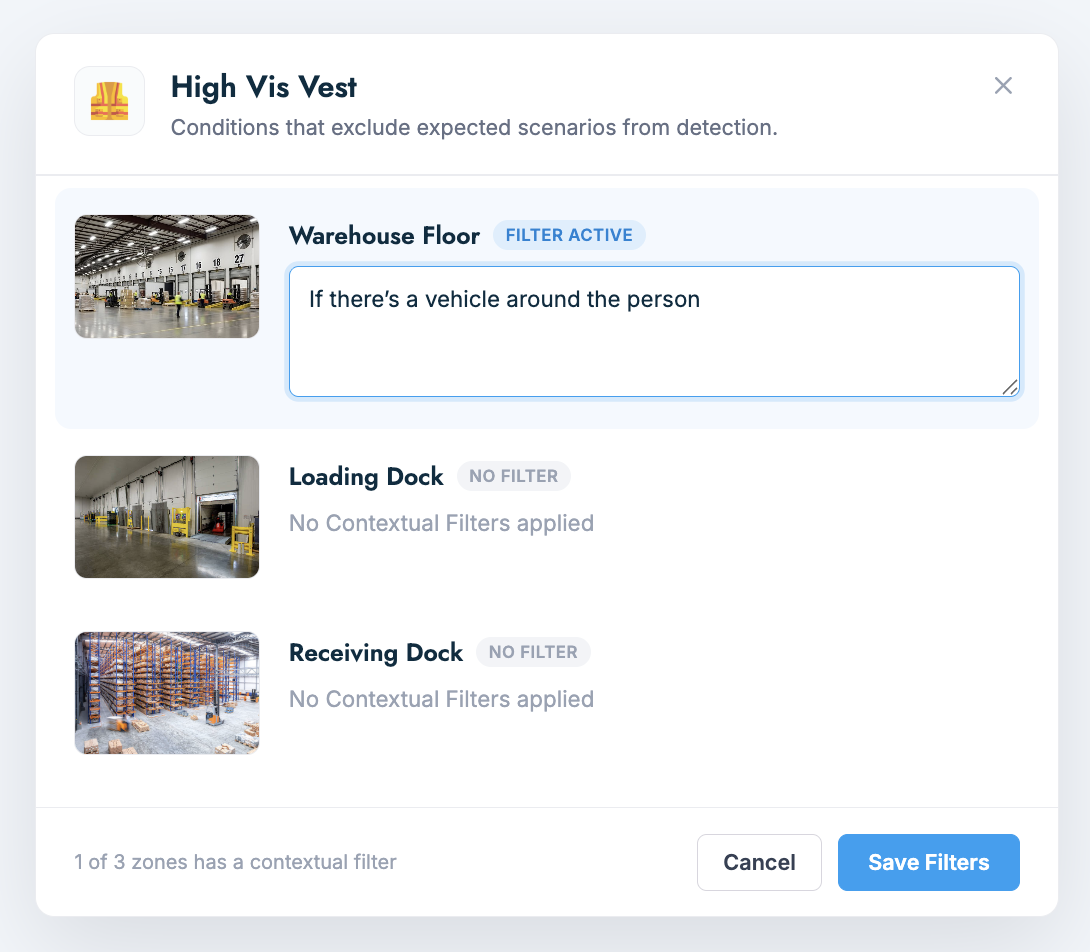
When the detector raises a candidate event, Protex AI evaluates the prompt against the clip and returns true or false. The event gets flagged or filtered before it reaches the user.
This is the single largest noise reduction we've shipped. A PPE rule without context produces hundreds of events per camera per day on an active site, and most are irrelevant. With a relevancy filter attached, the same rule produces tens of events, each worth the site team’s time.
Writing the condition is simple: no config file, no extra engineering resources. The same prompt can be edited, replaced or removed in seconds, and the same rule can carry different prompts at different sites or different shifts. Context becomes something that's configured rather than something engineers hard-code.
Context at scale: quantifying physical operations
Relevancy filters apply context one rule at a time. The next layer applies it to every event, automatically.
Vision-language models (VLMs) are a relatively new class of computer vision that can look at an image or video clip and answer questions about what's happening in it. The industry is looking at VLMs as a step-change from rule-based detections: point a camera, ask a question, get an answer.
For the last decade, that gap got closed by human review and hand-coded rules. Additional filters required one-off requests to an engineering team. VLMs help to close that gap; taking noisy detector output and applying the context that turns a signal into a decision.
VLM descriptors attach a full scene description to each event: "Forklift operating in aisle 3 at 14:32. Boxes stacked on pallet leaning at an angle." That description sits alongside the clip and the structured metadata. Every event becomes searchable.
Once all that context is codified, you can do things like semantic search ("show me when my dock doors were all occupied"), similarity ("find pallets that look like this one"), and pattern detection that no single rule would have caught. Pair your existing CCTV with VLM and it turns your entire operation into a quantifiable, searchable operational dataset.
Serious events shouldn’t compete for your attention
Context and filtering helps narrow down what you see. Ranking decides what you act on first.
Not all violations carry the same risk. A forklift speeding through a pedestrian crossing is a different conversation to a missing high-vis vest on a quiet aisle. Both are important. But if both events sit in a chronological queue, the serious one gets buried.
Protex AI also has automatic severity ranking. Severity is pre-assigned by risk type based on IOSH and NEBOSH guidance. Vehicle speeding and person/vehicle near miss are Catastrophic. PPE violations are Minor. Every rating is editable if your site operations call for something different.

But some operations may still have dozens to hundreds of forklift events. So within each severity bucket, we rank by how dangerous an event is and whether the two parties could see each other coming. For near-miss events, that score runs on two dimensions: physical risk (speed, distance) and an awareness score that captures whether they had line of sight. The highest-risk events surface at the top.
All of this behind-the-scenes ranking (with a date filter on top) means a shift manager can triage the week's most serious events in minutes rather than hours. Here's what this looks like behind the scenes - a backend view at the data informing how priorities get surfaced:
.gif)
Where the industry is going
For years, getting more out of computer vision meant better detection. More cameras, higher accuracy, broader coverage. But the sites that are getting real value have moved past that question. What they're asking now is simpler: of everything that reached my team this week, how much of it actually needed a response?
That number - across safety violations, process deviations, operational anomalies - is the one that tells you whether the system is working. The output isn't a stream of alerts. It's an operational intelligence platform teams can actually use, and it's what we're building now.
Check Out Our Industry
Leading Blog Content
EHSQ industry insights, 3rd Gen EHSQ AI-powered technology opinions & company updates.
.jpg)
.avif)
.avif)