

%2520(28).png)
When an incident happens, the pressure is on for your safety, legal, and compliance teams. You have to put together a complete evidence pack that will hold up in an audit but also respects employee privacy.
The old way of manually pulling CCTV footage is slow, often incomplete, and opens up a lot of data risk. With Protex.ai, you can replace that manual work with incident evidence AI that automatically creates audit-ready safety evidence and a fast claims defense video. It also protects privacy with advanced anonymization, encryption, and strict retention controls, all tracked in unchangeable audit logs.
This approach helps your teams respond to claims and audits with confidence. The benefits are pretty clear:
- Complete and Verifiable Evidence - The AI gathers synchronized footage from multiple cameras, adds standard labels, and keeps a verifiable chain of custody.
- Built-in Privacy Protection - With on-device anonymization, end-to-end encryption, and tight access controls, you reduce data exposure right from the start.
- Audit-Ready Documentation - Tamper-evident logs and structured data exports give auditors and claims adjusters the proof they need to validate your records.
- Accelerated Response - Automated workflows can often cut preparation time from days to minutes, delivering a full claims defense video and evidence pack much faster.
What Counts as Claims-Ready Evidence?
Auditors, claims adjusters, and privacy counsel all expect incident documentation to be complete, verifiable, and easy to share without creating new data risks. Claims-ready evidence is more than a video clip.
It's a whole package that tells a clear, factual story of what happened, backed by data that proves its integrity. This audit-ready safety evidence has to stand up to detailed scrutiny, giving you a clear record from the moment it’s captured through to review.
Evidence standards list
To hold up in an audit or legal proceeding, an evidence pack needs a consistent set of structured data. Each piece adds a layer of context and verification.
- Synchronized timestamps - Precise, network-synchronized time data proves the exact sequence of events across all your cameras.
- Camera ID, Site, and Zone - This information shows the physical location and perspective of the footage, so there’s no confusion about where it happened.
- Event Label and Severity - Standard labels (like "Slip, Trip, Fall," or "Struck-by Object") and severity ratings (High, Medium, Low) classify the event for quick analysis and reporting.
- Near-Miss Tag - Identifying near-misses gives you leading indicator data for proactive safety improvements and supports a full risk assessment and near-miss reporting.
- Human Reviewer Name and Decision Notes - Documenting who reviewed the event and their analysis adds a layer of human accountability to the AI-generated data.
- Export Hash - A unique cryptographic hash (think of it like a digital fingerprint) for exported files proves the evidence hasn't been touched after it was created.
These elements all work together to support OSHA recordkeeping and give you the detailed documentation needed for any legal review.
Data integrity basics
Preserving the chain of custody means putting technical controls in place that make any tampering obvious and confirm where the evidence came from. The following controls help keep evidence admissible and auditable for review.
- Hashing and tamper detection - Hashing algorithms such as SHA-256 generate unique digital fingerprints for each evidence file, so even a tiny alteration changes the hash and immediately flags potential tampering for auditors and reviewers.
- Digital signatures and provenance - Digital signatures confirm the identity of systems and people who handled files by binding signer credentials to the data, creating cryptographic proof of origin and handling for the chain of custody.
- Write-once storage and preservation - Write-once, read-many storage prevents overwriting or deletion of original evidence, preserving the initial file state so auditors can compare exports to originals during integrity checks.
- Clock synchronization for timelines - Clock synchronization across cameras and servers ensures consistent, network-synced timestamps so event sequences match across systems and misaligned clocks do not undermine the timeline for auditing purposes.
- Tamper-evident audit logs - Tamper-evident audit logs record every action on evidence with user, reason, timestamp, IP address, and outcome, creating an exportable history that supports forensic review and compliance.
Manual vs AI-assisted evidence
The difference between manual evidence collection and an AI-assisted workflow is significant for any busy safety or legal team. An incident evidence AI platform automates the most time-consuming and error-prone steps.
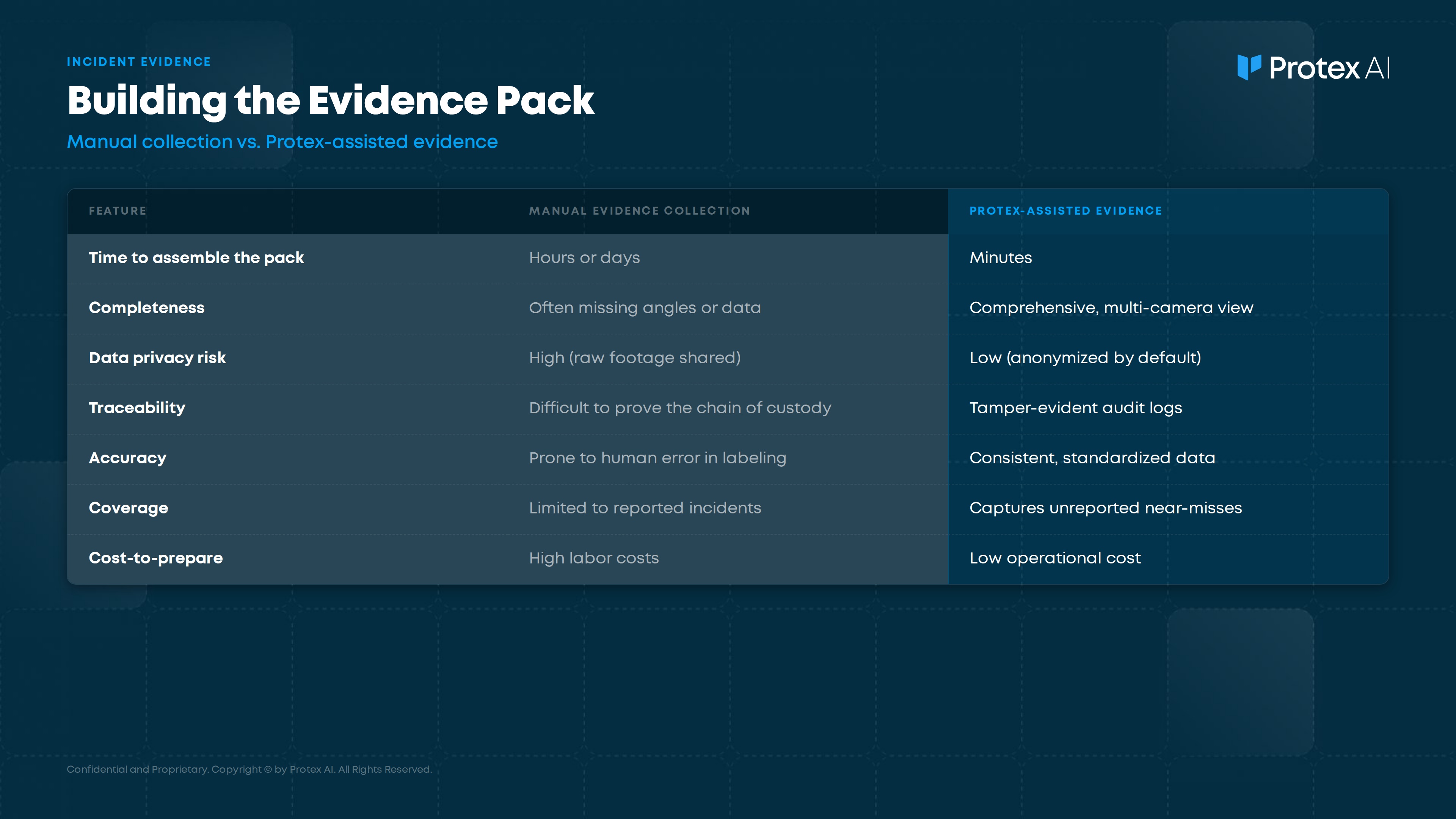
OSHA recordkeeping signals
Structured incident data directly helps you stay compliant with OSHA regulations. Incident labels made by AI can map to OSHA recordable criteria, like the type of injury or event.
This data helps you quickly fill out OSHA 300 and 301 forms with accurate information about days away, restricted duty, or medical treatment cases. During an audit, this consistent, time-stamped data makes it simple to show you’ve been diligent with your recordkeeping, and many teams support this work with safety tracking software.
Privacy Controls That Keep Footage Compliant
A modern CCTV system with privacy-safe analytics can produce a claims defense video without exposing personal data when it's not needed. These controls are not optional if you want to build trust with employees and meet regulatory requirements.
Anonymization methods
Privacy is protected through multiple layers of anonymization. On-device blurring can automatically block out faces and other personally identifiable information before the footage is even stored. Background masking can hide areas of the facility that aren't relevant to the incident.
Pseudonymous IDs replace real identities with temporary ones, allowing for analysis without revealing who is in the video. The original, unredacted footage is kept under strict, restricted access and put on legal hold only when it's required for an official investigation.
Encryption end-to-end
All data, whether it's moving or sitting still, must be protected by strong encryption. Data going from cameras to servers should use Transport Layer Security (TLS). Stored data should use strong encryption standards, such as AES-256.
A secure system also includes strong secret management for cryptographic material, with regular rotation of secrets and a clear separation of duties for administrators who manage encryption credentials.
Access controls
Access to sensitive incident data must follow the principle of least privilege. Put simply, people should only see what they need to see for their job. RBAC ensures users can view or manage only the data assigned to their job functions. Security gets even stronger with single sign-on (SSO) and multi-factor authentication (MFA).
Automatic session timeouts prevent anyone from accessing data from an unattended workstation. For higher-level access to original footage, approval workflows should require a sign-off from legal or privacy teams. Regular access reviews help auditors and privacy counsel confirm that permissions are still appropriate.
On-prem processing
Edge inference, where AI models run on devices located near the cameras, is a great way to minimize data. This setup lets the system analyze video and identify incidents right on-site. It sends only anonymized clips or structured metadata to the cloud. This approach significantly reduces the amount of sensitive data leaving your facility. For higher security needs, options like trusted execution environments can further isolate data processing.
Retention policies
A clear data retention policy is a core part of data governance. A retention matrix should define how long footage is kept based on how serious an incident was, its claims status, and regional rules.
For example, a high-severity incident that leads to a claim might be placed on an indefinite legal hold, while a low-severity near-miss with no claim might be deleted after 90 days. The system should give you proof of deletion and have a formal process for approving any exceptions.
Immutable audit logs
Every action related to incident evidence needs to be logged in a way that can be independently checked. An unchangeable audit log records the user, why they accessed it, the action they took, the timestamp, what was affected, the location, IP address, and the outcome. These logs should be kept for a set period and must be exportable for external review by auditors or legal teams.
CCTV integrations
To keep an unbroken chain of evidence, an incident evidence AI platform must connect directly with your existing cameras. Seamless CCTV integrations make sure that the origin of the footage is preserved from the moment of capture through analysis and export. This eliminates gaps where data integrity could be questioned.
Audit Workflow – Collect, Label, Export
A practical, step-by-step process helps cross-functional teams produce audit-ready safety evidence with very little friction. This workflow ensures consistency, completeness, and compliance.
- Collect footage - Automatically retrieve video from all relevant cameras, including pre- and post-incident buffers, immediately hash original files to preserve integrity, and create redacted review copies stored separately to limit exposure.
- Label incidents - Apply a standard taxonomy to record hazard type, severity, injury status, root cause category, and corrective actions, add reviewer name and confidence notes, and export structured data to dashboards like Protex Intelligence for trend analysis.
- Review with counsel - Have privacy counsel confirm the legal basis for sharing, verify redaction quality and privilege concerns, decide on any legal hold, and document the sign-off in the case record before external disclosure.
- Chain of custody - Record every custody event with digital signatures at each handoff, from capture through analyst review and legal approval, creating a verifiable, unbroken trail that proves origin and handling for auditors.
- Export evidence pack - Bundle all materials into a single pack that includes the claims defense video, still frames, event timeline, sensor data, related forms, corrective action records, machine-readable metadata (CSV/JSON), and a human-readable PDF summary.
- Handover and storage - Share the pack through a secure portal that uses encryption with expiring links or watermarking, where supported. Store it according to your retention policy, log all access, and manage the process through integrated reporting & workflows.
FAQs – Claims-Ready Video Evidence and Privacy
Is an anonymized video admissible?
Courts generally focus on whether evidence is properly authenticated, and that can include redacted material. An anonymized video is more likely to be accepted when the original, unredacted footage is preserved under strict, restricted access with enterprise privacy and security controls and both versions are verified with cryptographic hashes.
How long should incident footage be kept?
Retention policies depend on your location, industry, and the specifics of a claim. Many organizations keep non-incident footage for 30–90 days, while investigation, injury, or litigation footage is placed on legal hold and retained until the matter is resolved, in line with local regulations and internal policy.
What is an audit trail for safety incidents?
An audit trail is an unchangeable, time-stamped record of every action on case materials — who accessed the data, what they did, when and where, and why. These logs need to be exportable for auditors to review.
Who is the data processor in CCTV analytics?
Controller versus processor roles depend on the service agreement. Typically, the company that owns the facility and decides why data is collected is the data controller, and the analytics vendor, like Protex.ai, acts as the data processor under the controller’s instructions in a Data Processing Agreement (DPA).
Do AI labels stand in court?
AI-generated labels are best used as supporting evidence, especially when a human reviewer validates them. Combining machine-generated tags, reviewer confirmation, confidence notes, and preserved original footage creates a defensible record that supports admissibility.
Compliance Notes – Standards and Jurisdictions
Connecting privacy-safe AI to regulatory frameworks is a must for showing compliance.
OSHA recordkeeping tips
Using an OSHA recordkeeping AI approach with structured incident data makes compliance a lot simpler. Consistent labels and timestamps feed directly into OSHA 300 and 301 forms, speed up the creation of annual summaries, and give auditors the clear, consistent documentation they need.
GDPR video guidance
Under GDPR, organizations using video surveillance have to establish a clear legal basis, conduct a Data Protection Impact Assessment (DPIA), and use clear signage. Anonymization and on-premise processing are great data minimization techniques. For internal alignment, document your safety data collection and processing practices as part of your governance model.
ISO 27001 mapping
The controls we've talked about here align with an Information Security Management System (ISMS) based on standards like ISO 27001. They map to control families covering access management, cryptography, secure operations, and logging and monitoring.
Data residency
Modern safety and analytics platforms give you options for regional data hosting to help meet data residency requirements. Keeping personally identifiable information on-premises whenever possible is a best practice for reducing cross-border data transfer exposure and simplifying compliance.
Proof Points You Can Validate
The features that make claims-ready, privacy-safe evidence possible are available for you to review.
Privacy-safe processing
Non-identifiable video processing, on-device redaction, and metadata-first workflows limit data exposure from the very beginning. See how Protex Intelligence turns anonymized data into actionable safety insights.
Audit-ready reporting
Dashboards, case timelines, export hashes, and unchangeable logs support defensible recordkeeping for any audit. Explore our Reporting & workflows to see how evidence packs are built and managed.
Camera estate fit
Our platform is designed to work with most modern camera systems and existing NVRs, preserving the chain of evidence without you needing to do a complete hardware overhaul. Learn more about our flexible CCTV integrations.
Request a Privacy & Audit Walkthrough
Invite your EHS, Compliance, Legal, and IT Security teams to see how privacy-safe AI delivers defensible evidence.
Learn more about privacy-safe, audit-ready evidence with Protex.ai.
Check Out Our Industry
Leading Blog Content
EHSQ industry insights, 3rd Gen EHSQ AI-powered technology opinions & company updates.
.jpg)
.avif)
.avif)