
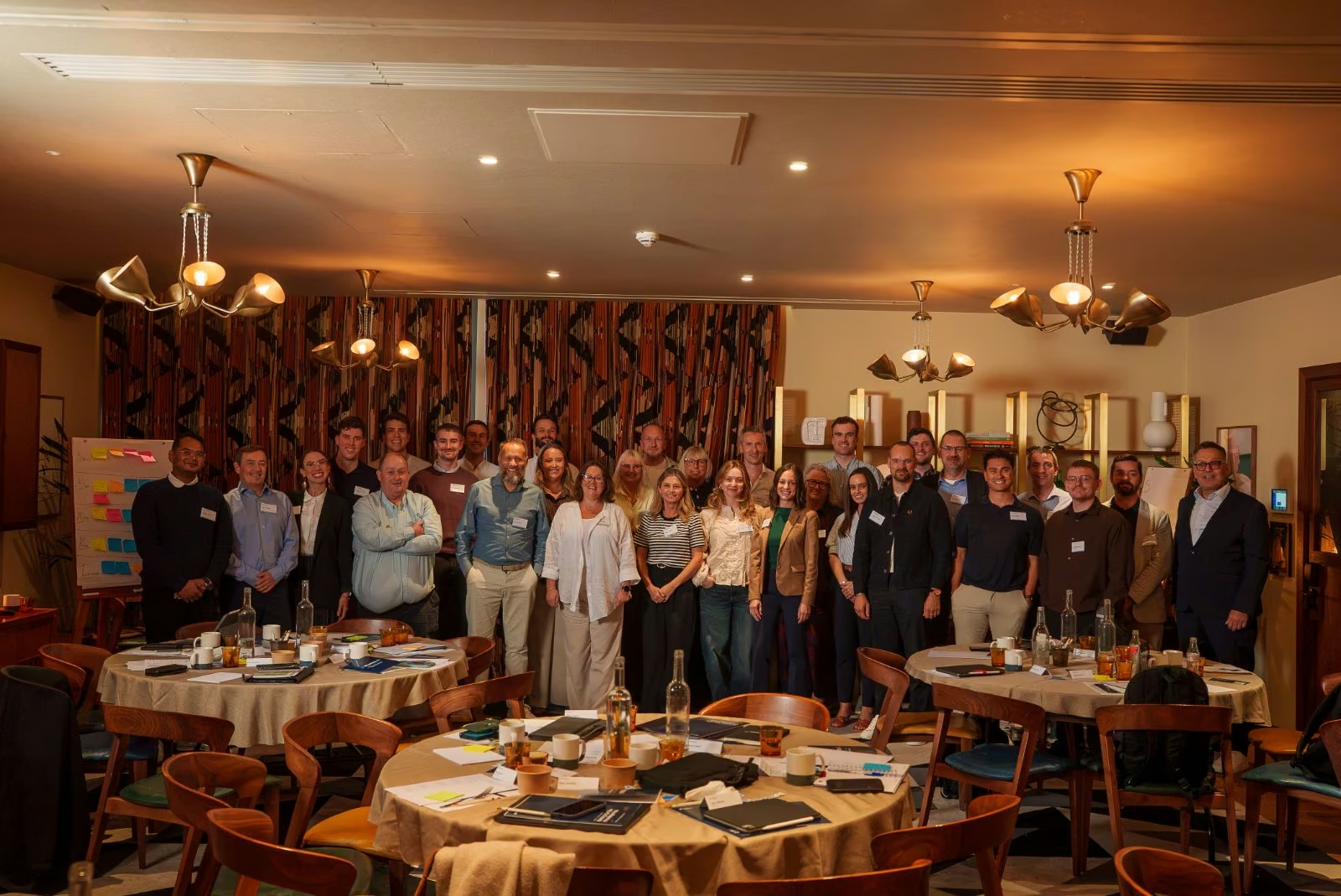
Written by Scott Cahill, Head of EMEA Sales
I interview a lot of salespeople. And one thing I've noticed is that the candidates who thrive on my team aren't necessarily the ones with the most polished pitches — they're the ones who walk in genuinely curious, hungry, and completely honest about how they've worked, where they've failed, and what they've learned.
Protex AI is building the platform for AI-powered workplace safety and operational efficiency. We're selling into large industrial organisations across EMEA — logistics, manufacturing, food and beverage, warehousing — where the stakes are real and the buying process is complex. When I'm building out my sales team, that context shapes everything about how I hire.
Here's what we’re evaluating when you sit across from someone on our team, and what we’d tell you to prepare.
The bar we hire to
Let's start with the experience baseline, because there's no point going through a six-stage process if this isn't a fit for either of us.
I'm looking for people who have carried meaningful quota — typically $1M+ — and closed six-figure deals with sales cycles that stretch six to nine months or longer. In EMEA, that means genuine multi-stakeholder selling: navigating procurement, legal, IT, works councils, operations, and executive buyers, often simultaneously. If your deals have mostly been inbound or product-led with a short close, this probably isn't the right seat for you.
Pipeline ownership matters just as much. When we talk, I want to understand what percentage of your pipeline you built yourself and exactly how you built it. There's no magic number, but I'm hiring into a market where self-generation is non-negotiable. Candidates who've relied heavily on SDR-sourced or inbound-only pipeline will struggle here, and it's better to be upfront about that from day one.
What I'm looking for beyond the CV
Your CV gets you in the door. What gets you an offer on my team is harder to articulate on paper, but unmistakable in conversation.
Competitiveness. Not aggression — edge. The reps who stand out to me are the ones who genuinely hate losing. When I ask you about deals you've lost, I'm watching your reaction before I even listen to your answer. The best AEs I've ever managed have a slight chip on their shoulder about a deal that got away. That energy matters when you're fighting for enterprise budget.
Coachability. This is the one that surprises people. I'm not looking for someone who nods along and agrees with everything I say — I'm looking for someone who has a clear example of receiving tough feedback, sitting with it, and actually changing how they sell. Self-awareness is a superpower on a sales floor, and it's rare.
Ownership. Did you build your territory, or did you inherit it? When pipeline dried up in Q3, what did you do? This isn't a team where you can sit back and wait for the system to feed you. The best AEs I work with operate with a bias for action that others would call urgency.
A reason to be here. I always ask: what are you trying to prove, and why Protex? The candidates who give a real answer — not a rehearsed, corporate answer, a real one — are the ones I remember. Our mission is protecting industrial workers from serious injury and fatality and driving operational efficiencies across our client sites. That resonates with some people immediately and doesn't with others. I want people on my team who actually care about what happens on the shop floor.
What the process looks like
Six stages sounds like a lot. Here's why each one exists, and where I come in.
- Stage 1 (Recruiting, 30 min): Our recruiting team confirms the experience baseline and listens to how you communicate. Clear, direct, no jargon. We're not trying to catch you out — we're making sure it's worth both our time to go further.
- Stages 2 and 3 (Me and 1-2 reps, two separate conversations): These are our two deep dives. The first is about traits — who you are, how you think, what drives you. The second is about execution — how you actually run a deal from cold outreach to signature. I deliberately separate these so neither conversation has to do everything, and I can get a real sense of how you operate.
- Stage 4 (60-min case study): This is the most revealing stage. You'll walk me and another sales leader through a deal you won and a deal you lost — I'll come back to why the loss matters. I'm not grading you on delivering a flawless script. I'm watching how you listen, how you ask second-level questions, and how you respond when a buyer pushes back.
- Stage 6 (CEO, if not covered in Stage 5): Executive alignment and cultural fit. By the time you get here, I've already signed off on your sales capability. Dan is assessing presence, judgment, and whether you truly understand what Protex is building.
The deal you lost
Candidates always over-prepare the deal they won. The deal you lost is where the real conversation happens.
I'm not looking for you to have lost gracefully — I'm looking for accountability and a learning mindset. Did you recognise the risk early or late? What would you do differently tomorrow? The candidates who look me in the eye and say, "Honestly, I should have multi-threaded earlier," or "I didn't qualify the economic buyer properly until it was too late" are showing me the exact self-awareness and deal-inspection maturity I want on my team.
The candidates who explain a loss as primarily external — bad timing, a competitor with cheaper pricing, a sudden change in leadership — rarely make it past my round.
What to prepare
- A major deal you won. Know it cold: your discovery process, the stakeholder map, how you built and tested your champion, how you navigated procurement and legal, and what actually created urgency for the buyer.
- A major deal you lost. Be brutally honest about your part in it.
- Your sales philosophy and pipeline generation story. What was your self-generated percentage? How did you break into cold accounts? What outbound approaches actually worked for you?
- A moment where you received feedback that changed how you sell.
- Your answer to: What are you trying to prove, and why does Protex's mission resonate with you?
And read the website. I'll notice within two minutes if you haven't.
One more thing
Our process is thorough because selling enterprise AI into business-critical environments is hard, and I take the people I bring onto this team seriously. The buying decisions are complex and the real-world impact is massive. I want AEs who match that seriousness — people who are ambitious, honest, process-driven, and genuinely excited to build a market-defining company across EMEA.
If that's you, I'd love to have you on my team.
Interested in EMEA AE roles at Protex AI? View open positions at jobs.ashbyhq.com/Protex AI or reach out to me directly on LinkedIn.
Check Out Our Industry
Leading Blog Content
EHSQ industry insights, 3rd Gen EHSQ AI-powered technology opinions & company updates.
Related content
Why forward deployed engineering matters at Protex AI

A day in the life: Business Development Representative at Protex AI