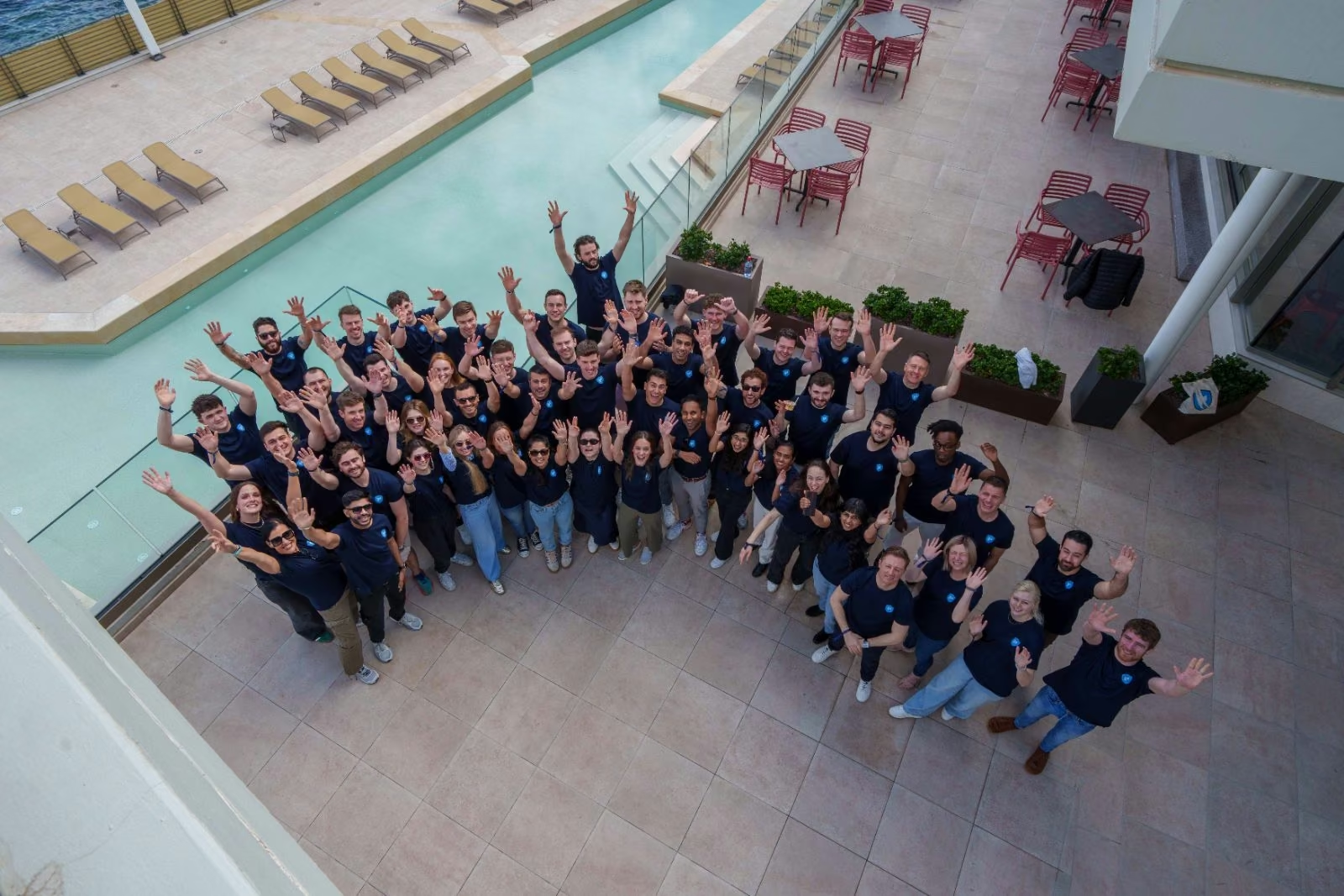
Declan Gallagher is an Implementation Manager at Protex AI and has been with the team for 3 years.
There's a moment on every install that never gets old. The device is racked, the cables are in and we're all standing around a laptop waiting for the first camera feed to come through. Then it does, and someone on the client's team says "oh, that's our dock".
The Implementations team is the bridge between a signed contract and a working system. Sales wins the deal. Customer Success helps the site get value from it. In between, someone has to get a GPU into a server room, connect it to dozens of cameras across someone else's network and prove that it's detecting the right things. That's us.
It's part project management, part network engineering, part diplomacy. No two sites are the same, and that's exactly why I like it.
From signed deal to live cameras
Every new site follows the same broad journey, even if the details change every time.
From signed deal to live cameras
Target: around 30 days from contract to cameras connected
- Get to know the siteThe client fills in our Technical Delivery Form, one row per site and one per camera. It tells us where the cameras are, how they stream, what risks they want to watch for and who we need to talk to.
- Technical kickoffBefore anything ships, we sit down with the client's CCTV, IT, network and security leads. We walk through how Protex works, what we need from them and what their network needs to allow. This call saves more pain than anything else we do.
- Prepare and ship the deviceWe order the edge device, check it's set up correctly for the site and region before it leaves the supplier and track it all the way to the loading dock.
- Install and connectOn site or remotely, we get the device racked, cabled and online, then connect each camera stream and calibrate it.
- Test before we hand overWe run a test rule on every camera and review a sample of real events, checking video quality, detection quality and false positives. If something isn't right, we investigate and test again.
- Hand overOnce the site passes QA, it goes to Customer Success, who take it from "the system works" to "this has changed how we run the site".
Our target is to get a site from signed contract to cameras connected in around 30 days. Some sites go faster. Some, honestly, don't, and the next section explains why.
Life on site
A lot of installs happen remotely now, with the client's own IT team or CCTV installer doing the physical work while we guide them through it. But some sites need us there in person, and those are the days people on the team talk about.
You might be in a server cupboard that was never designed to hold a GPU workstation, working out with the client's network team which port goes where. You might be standing on a mezzanine with a site manager, looking at a camera pointed slightly too high to see the forklift lane it's meant to cover. You learn very quickly that the drawing you were sent and the building you're standing in are not always the same thing.
On larger rollouts the work looks different again. When a customer wants to bring dozens of sites live, we plan them in waves, with a pilot wave first to prove the process before settling into a steady rhythm. It's a big logistics puzzle across shipping, security reviews, network teams and time zones, and getting it right is really satisfying.
The hard problems
Every network is different
Our device has to reach the client's cameras on one side and our cloud on the other, and it has to do it inside some of the most locked-down corporate networks in the world. Firewalls, proxies, SSL inspection, separate camera and internet networks: we see all of it. A lot of the job is detective work. When a device goes quiet, is it the firewall? A proxy that someone added last month without telling anyone? A connection that gets silently dropped after a few minutes of quiet? Working that out with a client's IT team is a skill, and our team has become very good at it.
Cameras aren't always what they seem
An IP address and a port number are not the same as a working camera stream. We regularly find cameras that stream at the wrong resolution, PTZ cameras that move around, fisheye lenses that need special handling or cameras pointed at exactly the wrong spot. Part of the job is setting expectations early and helping clients pick the cameras that will actually give them good results.
Many people, one plan
On a single install I might be working with the client's project manager, their IT lead, their network team, their security team, an external CCTV installer and our own engineering, QA and Customer Success teams. Everyone has their own priorities and their own calendar. Keeping all of them pointed at the same go-live date is half the job.
Not letting "nearly done" count as done
It's tempting to call a site finished when the first camera image appears. We don't. A site isn't done until every camera is producing good events, it's been through QA and it's been properly handed over. Holding that line, even when everyone wants to move on, is what makes the customer's first impression a good one.
The team and how we work
We're a small team that works closely with almost every other part of Protex. Sales bring us in early to check that a site is technically ready. Engineering are our first call when a device does something strange. Customer Success pick up where we leave off.
Jira is our home base. Every install is a project with its own tasks, from booking the install to the final handover, so anyone can see exactly where a site is at a glance. We've built up a library of guides for everything from configuring a client's proxy to calibrating cameras, and we keep improving them after every tricky install.
We've also been bringing AI into our own work. Some of the team now start the day with an automated digest that pulls together what's changed across their installs overnight, so they know where to focus before they've opened their inbox. Others use AI to draft technical kickoff decks and keep site details organised. It means more time solving real problems and less time chasing status updates.
Why people love it
You see the results of your work right away. When a site goes live, you know you made it happen. You also get a view of the business very few people do: you've been inside the server rooms, met the IT teams and walked the floors of some of the world's biggest manufacturers and logistics companies.
And you learn fast. Networking, Linux, video streaming, cloud infrastructure, project management and stakeholder management all in one role. People leave every install knowing more than they did when they arrived.
What I'd tell you before you apply
You'll need to be comfortable not knowing. Every site throws something new at you. The people who do well here enjoy that rather than dreading it.
Technical curiosity matters more than a perfect CV. If you've worked with networks, Linux or video systems, great. If you haven't but you love figuring out why something isn't working, we can teach you the rest.
Being organised is a superpower. The technical problems are interesting, but what makes an install go smoothly is knowing exactly what's outstanding, who owns it and when it's due.
Check Out Our Industry
Leading Blog Content
EHSQ industry insights, 3rd Gen EHSQ AI-powered technology opinions & company updates.
Related content
Why forward deployed engineering matters at Protex AI

A day in the life: Business Development Representative at Protex AI