Smart Innovators: Video Analytics For Safety
This report explores how video analytics is transforming workplace safety, helping organizations move from reactive incident response to proactive risk prevention using AI, computer vision, and emerging technologies.


Summary for decision-makers

Firms confront safety blind spots with real-time video intelligence
Video analytics for safety has rapidly evolved into a high-impact technology in modern safety management. It is transforming how organizations detect and prevent risk by leveraging machine learning and computer vision.
These systems can identify patterns in video footage, detect unsafe behaviors, and trigger actions or recommendations in real time. Proven use cases include detecting PPE non-compliance, securing restricted zones, and improving driver safety.
As organizations shift toward proactive safety management, computer vision is emerging as a key enabler of safer and more compliant workplaces. This report provides a benchmark of the current video analytics market and helps buyers guide their future technology adoption strategies.

EHS leaders turn to video analytics as traditional safety models struggle to keep pace
EHS professionals are operating in an increasingly complex risk environment. The effectiveness of traditional safety approaches is stretched by the compounding impacts of workforce shortages, greater reliance on contractors and heightened pressure to reduce SIFs. As a result, organizations increasingly seek technologies that provide greater visibility into operational risk. Video analytics is emerging as a compelling solution, enabling the continuous monitoring of workplace activities and automated detection of unsafe conditions.
By augmenting human oversight with Al-driven insights, firms can actively address a range of safety challenges that they may previously have struggled to handle. With strong operational viability, video analytics is gaining traction as a high-impact technology within EHS programmes, driven by:
Video analytics technology can enable the real-time detection of unsafe acts and conditions, addressing those persistent accidents which, historically, organizations have failed to reduce through lagging indicator approaches. In video analytics, convolutional neural networks (CNNs) analyse video feeds to identify hazards such as line-of-fire exposure, unauthorized zone entry and vehicle-pedestrian interactions, helping to prevent falls from height, struck-by incidents and transportation accidents.With an increased focus on potential SIF (pSIF) reduction, these systems can also identify near-miss events that often go unreported, allowing organizations to intervene early and address hazards before injuries occur.
Vendors such as Intenseye and Protex AI have focused on building partner networks with broad EHS software platforms, to enable easy integration. By unifying video-derived insights with broader operational data, organizations gain enterprise-wide visibility into risk.
With computer vision benefits seen across functions – including safety, quality and operations – firms should seek to leverage cross-functional data collection.
Modern video analytics platforms leverage deep learning models to detect PPE compliance, posture, motion and complex human-machine interactions with increasing precision. With flexible deployment across edge and cloud environments, coupled with integration into existing CCTV infrastructure or mobile applications, upfront costs are minimized.
At the same time, improvements in contextual understanding and false-positive reduction have increased trust in the technology, while built-in privacy-preserving features such as blurring and anonymization address regulatory and workforce concerns.
Positive use cases have emerged, validating the deployment of the technology in safety applications. Global bottling business Swire Coca-Cola, for example, implemented Intenseye’s computer vision technology, seeing a 60% reduction in hazard detection. A logistics provider, meanwhile, enjoyed an 85% decrease in area control risks and a 62% lessening of incidents after implementing Surveily’s AI-powered solution.
Ongoing skills shortages have reduced the number of experienced workers on site, increased reliance on contractors and temporary labour, and stretched the capacity of traditional safety supervision. Higher workforce turnover also introduces greater risks, as new workers are statistically more accident-prone and the effectiveness of safety training varies widely across roles and locations.
Video analytics helps organizations adapt to these realities. Acting as a 24/7 digital safety observer, the technology can continuously monitor work environments and identify risks across shifts and sites.
Strategic partnerships and investment injections reshape the competitive landscape for video analytics vendors
Skills shortages and rising expectations for stronger safety performance are driving demand for video analytics. As the technology matures, vendors are responding with increased investment and strategic partnerships to scale their capabilities (see Figure 1). Verdantix finds that:
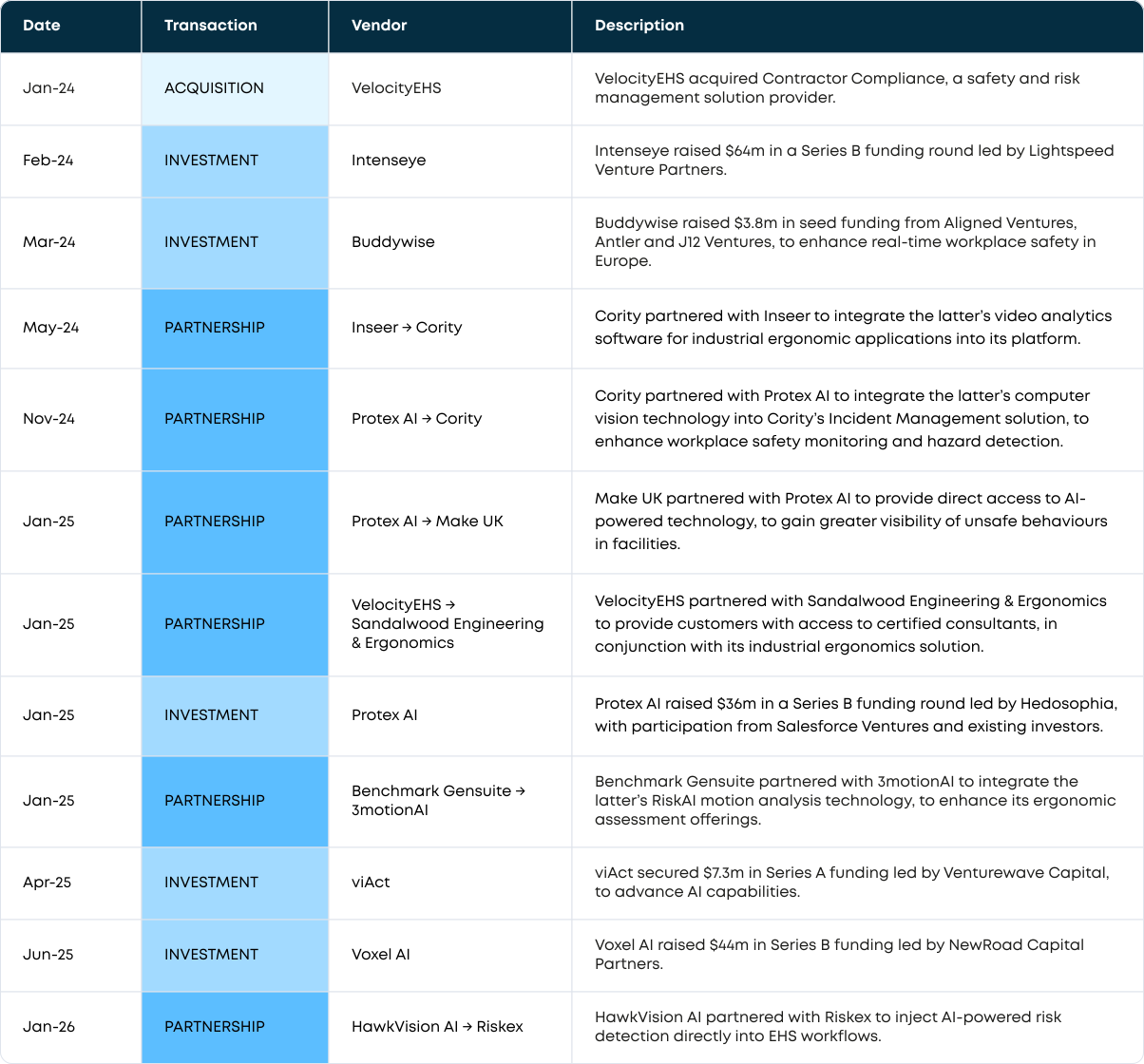

At the same time, some EHS-native platforms are moving into the video analytics space, developing solutions which are, by design, deeply embedded within EHS workflows. Most notably, VelocityEHS offers a market-leading motion capture ergonomics solution. Quentic (an AMCS company), meanwhile, is strengthening its position in the market with the planned launch of a video analytics solution in 2026/27, focused on risk detection across unsafe conditions, behavioural safety and PPE monitoring.
This underscores a clear prioritization of interoperability and seamless integration across EHS platforms, boosting market accessibility and providing strong directional growth for video analytics applications across EHS. Vendors that prioritize strong partner networks will be viewed with favour by prospective customers.
These developments indicate strong backing and growth within computer vision technology. The influx of investment resulted in major product developments from video analytics vendors throughout 2025, with faster and more accurate real-time processing, and improved hardware technology.
Sectors such as manufacturing, logistics, construction, energy and transportation have moved first, deploying video analytics to address critical exposure areas, including SIF risks.
However, strong pilot programmes are also emerging in traditionally lower-risk sectors, as organizations recognize the value of proactive hazard detection.
These early pilots lay the groundwork for broader adoption, signalling that video analytics is evolving from a high-risk application into a foundational safety capability across a wider range of industries.
Early adopters report measurable results, such as reductions in incident rates, improved PPE compliance, decreased near-miss severity and faster corrective action cycles.
These improvements hit the bottom line directly, through avoided incidents, lower insurance premiums, reduced operational downtime and stronger safety culture metrics.
As organizations increasingly validate these benefits at scale, video analytics shifts from a ‘nice to have’ innovation to a defensible, value-driven investment supported by both safety leaders and executive stakeholders.
Introducing the video analytics market for safety applications
The video analytics vendors discussed in this report focus on delivering solutions that address core safety priorities and risks. Verdantix defines video analytics for safety as:
To gain an in-depth understanding of how video analytics is used within safety applications, Verdantix evaluated 10 video analytics providers. Among the evaluated vendors, nine specialize in safety risk detection: Buddywise, HawkVision AI, Intenseye, Protex AI, Surveily, viAct, Visionify, visionplatform.ai and Voxel AI.
One vendor – Milestone Systems (BriefCam) – focuses on security, but also offers dedicated safety capabilities.
Our scoring provides a structured view of where solutions differentiate and how the market is set to evolve as firms strive for proactive safety management.
Understanding the EHS video analytics vendor landscape
Video analytics plays a critical role across multiple EHS applications, targeting distinct safety, health and environmental priorities.While this report focuses on core safety use cases, we identify five broader EHS usage scenarios (see Figure 2), covering:


Vendors such as Ambient.ai, Milestone Systems (BriefCam) and Pelco analyse video streams to detect unauthorized access and threat indicators (such as gunshots and firearms), and for people-counting, to manage occupancy.
By combining object detection, behaviour analysis and contextual awareness, security-focused platforms can distinguish suspicious or escalating situations and trigger alerts for rapid response.
They typically integrate with access control systems and video management platforms, enabling faster investigation and coordinated incident response.
Prioritizing precision, low latency and situational awareness, security computer vision technology helps firms protect their people, assets and facilities.
For safety applications, these platforms typically analyse live or recorded video and use neural networks to detect and classify objects of interest, such as people and body parts, vehicles, equipment, machinery and PPE.
Objects are tracked and analysed, with contextual awareness and safety-related rule logic. Computer vision can thus detect a broad spectrum of risks, such as PPE non-compliance, line-of-fire exposure, hazardous zone intrusions, unsafe equipment use, vehicle-pedestrian interactions, and working-at-height risks.
Video analytics platforms such as those offered by HawkVision AI, Intenseye and Protex AI integrate seamlessly with existing EHS systems to automate data flow and provide visibility across operations.
These key points form a digital human body, enabling the modelling of posture, movement and orientation, to assess how workers move and interact with their environment over time.
Posture is measured against established ergonomic assessment frameworks such as RULA (rapid upper limb assessment), REBA (rapid entire body assessment) and NIOSH (US National Institute for Occupational Safety and Health).
Vendors such as Inseer, Moovency and VelocityEHS provide data-driven insights into worker patterns that can lead to musculoskeletal disorders (MSDs) and cumulative strain, thereby supporting ergonomic assessments and job redesigns to improve wellbeing and reduce injury.
Combined with telematics and sensor data, events are contextualized using factors such as speed, driving conditions, proximity and braking.
Using inward and outward-facing cameras, the systems can detect unsafe driving behaviour, such as fatigue, distraction and mobile phone usage.
Platforms such as CameraMatics and MiX Telematics enable real-time driver alerts and coaching, as well as post-event review.
AI-powered platforms analyse live and recorded video streams to interpret what is happening across a facility – recognizing machinery in operation, monitoring how equipment is used and observing how people and vehicles move through workspaces.
By tracking activity over time and applying contextual safety rules, the systems can detect subtle deviations from normal operations.
Vendors such as Hikvision integrate with IoT sensors, supervisory control and data acquisition (SCADA) and other operational systems, correlating visual data with process conditions to enable predictive risk analysis.
Platforms such as AIVID and Spot AI surface deviations from standard operating procedures (SOPs) and highlight patterns of non-compliance.
Evaluated firms and selection criteria
Video analytics plays a critical role across multiple EHS applications, targeting distinct safety, health and environmental priorities.While this report focuses on core safety use cases, we identify five broader EHSVerdantix defined vendor inclusion criteria to ensure comparability across the featured platforms, narrowing down the inclusion to 10 vendors.
To evaluate firms’ capabilities, we requested evidence of functionality from all 10 vendors. We received supplemental information from eight vendors; for the remaining two, we reviewed capabilities outlined in the public domain. usage scenarios (see Figure 2), covering:
Firms solely specializing in security, ergonomics, fleet safety and training were excluded from the evaluation.
Video analytics for safety centres on five core capabilities and five technical capabilities
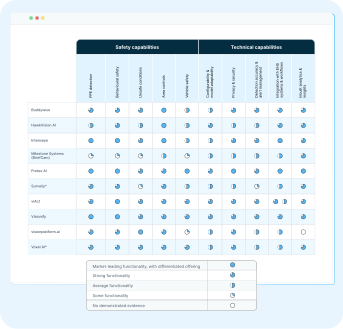
Video analytics solutions for safety applications target a common set of hazards found across industrial sites, warehouses and workplaces. Most vendors address core use cases such as PPE compliance, unsafe acts and conditions, restricted area monitoring and vehicle-pedestrian safety. Differentiation in the market therefore increasingly depends on technical capability rather than breadth of common use case coverage.
Leading vendors distinguish themselves through the quality of their model training, accuracy and reliability of detections, flexibility to configure custom safety rules, and depth of integration with existing operational and EHS systems (see Figure 3 and Figure 4). Prospective buyers should evaluate providers based on their ability to deliver:
Effective platforms balance industry-specific requirements with firm-wide governance, while still enabling site-level flexibility. Vendors achieve this by enforcing rule consistency across multi-site deployments to support global safety standards, while allowing local teams to tune rules to reflect site-specific risks and operational realities. Configurable parameters typically encompass occupancy limits, vehicle speeds, designated travel paths, geofencing boundaries, and restricted or hazardous zones.
Advanced platforms extend this flexibility, enabling organizations to apply rules at multiple operational levels, from enterprise-wide policies down to specific sites, zones, tasks, shifts or times of day. Some solutions also support temporary rule sets, allowing teams to introduce additional controls during maintenance, shutdowns or construction activities. Crucially, leading vendors embed customer feedback directly into the improvement loop, leveraging user insights to refine rules and continuously enhance system performance.
Effective platforms balance industry-specific requirements with firm-wide governance, while still enabling site-level flexibility. Vendors achieve this by enforcing rule consistency across multi-site deployments to support global safety standards, while allowing local teams to tune rules to reflect site-specific risks and operational realities. Configurable parameters typically encompass occupancy limits, vehicle speeds, designated travel paths, geofencing boundaries, and restricted or hazardous zones.
Advanced platforms extend this flexibility, enabling organizations to apply rules at multiple operational levels, from enterprise-wide policies down to specific sites, zones, tasks, shifts or times of day. Some solutions also support temporary rule sets, allowing teams to introduce additional controls during maintenance, shutdowns or construction activities. Crucially, leading vendors embed customer feedback directly into the improvement loop, leveraging user insights to refine rules and continuously enhance system performance.
Leading providers continuously process data on edge devices, delivering alerts in as little as a fraction of a second, and up to two seconds. However, even the best systems face challenges: false-positive alerts often arise when visual noise is not effectively managed.
Top providers tackle this problem through a blend of refined models, context-aware rules, human-in-the-loop feedback, verification processes, configurable thresholds and temporal filtering. Beyond mitigation strategies, vendors rigorously track accuracy metrics, monitoring model precision, maintaining alert volume stability, maximizing recall and minimizing false-positive rates, to ensure consistent, reliable performance.
Vendors such as Intenseye and Protex AI recognize this as a priority, cultivating robust partnerships with leading EHS software providers such as Benchmark Gensuite, Cority, Intelex, Sphera and Wolters Kluwer Enablon.
Other providers, including Intenseye and viAct, enhance integration through proprietary camera technology, enabling more efficient workflows. Intenseye’s Sentinel suite delivers heightened accuracy and faster performance, while viAct’s viMAC provides a comprehensive 360° view to bolster machinery safety.
Interactive dashboards serve as the centrepiece, offering dynamic safety scoring, heatmaps and hotspot visualizations that make trends instantly visible and actionable.


Next-generation AI capabilities drive vendor differentiation
Innovation continues to reshape the market as vendors push for greater automation and truly proactive risk management. Predictive AI capabilities and closed-loop systems lead this advancement, allowing firms to rely on computer vision to anticipate risks and strengthen safety performance across operations (see Figure 5). Verdantix finds that firms are innovating by:
These systems combine visual recognition with large language models (LLMs), enabling them to interpret complex scenes in ways that go beyond simple object detection. Instead of training a separate model for every rule, users can prompt the model in natural language, allowing it to process the video and instruction together.
AI can interpret complex events, contextualize worker behaviours within the broader environment, and enable semantic search over video footage. Natural language search allows safety teams to query video footage using plain language, while contextual safety analysis enables AI to understand nuanced risk patterns, helping organizations proactively address hazards before accidents occur.
For example, visionplatform.ai leverages VLMs to analyse video and produce structured natural language descriptions. By merging visual and linguistic intelligence, these innovations make video analytics not only faster, but far more actionable in creating safer workplaces.
Video analytics vendors can run many concurrent detection configurations at scale, such as for perimeter breaches, line-crossing, crowd anomalies, behavioural deviations and unattended objects. Agents blend vision-based models with contextual logic, allowing them to classify patterns, identify precursors to risk and convert raw detections into actionable insights.
Emerging platforms use AI to automatically draft safety narratives, generate event summaries, route issues into workflows and generate corrective and preventative actions. This is a trend aligned with broader EHS innovation, where AI systems leverage video, text and operational data to flag hazards and recommend preventative controls.
Employee training thus moves from generic, to targeted and evidence-based. With the emergence of VLMs, systems can generate natural language summaries explaining why certain behaviours increase risk, thereby enhancing psychological safety discussions and making coaching more accessible to frontline teams.
By embedding AI insights directly into coaching workflows, organizations can turn moment-in-time detections into habit-shaping learning moments. This closed loop, from observation to action, strengthens safety culture.
The system may identify patterns such as equipment malfunctions occurring alongside unsafe pedestrian movement, automatically triggering alerts or adjusting workflows. Advanced integration also allows for dynamic, cross-system responses, such as temporarily restricting access to high-risk zones or adjusting environmental controls in real time.
By combining contextual awareness with predictive insights and autonomous operational actions, the market moves from passive monitoring to intelligence-driven safety management.

Watch Our 2-Minute Demo Video
Looking to learn more about revolutionizing how you and your team make proactive safety decisions that help contribute to a safer work environment?